Salmon Reproductive Cycle: How Salmon Reproduce
Watching salmon swim upstream is dramatic, but reaching the spawning grounds is only the start of reproduction.
During this phase of the salmon life cycle, mature fish return to freshwater, find suitable spawning habitat, fertilise eggs, and leave the next generation beneath the gravel. The basic process is similar across salmon species, although Pacific and Atlantic salmon differ in what usually happens after spawning.
How Do Salmon Reproduce?
Salmon reproduce by spawning in freshwater. A female digs a gravel nest, called a redd, and lays her eggs in it. A male releases milt, which contains sperm, over the eggs, so fertilisation happens outside the female’s body.
The female then covers the fertilised eggs with gravel, where they remain while embryos develop. The National Park Service describes this same spawning process, including redd construction, egg release, fertilisation, and gravel covering.
The process can be summarised in six steps:
- Mature salmon return to freshwater spawning habitat.
- A female selects suitable gravel and prepares a redd.
- Males compete for access to spawning females.
- The female releases eggs.
- A male releases milt and fertilises the eggs.
- The female covers the eggs with gravel.
Why Do Salmon Return to Freshwater to Spawn?
Many salmon are anadromous. They begin life in freshwater, migrate toward the ocean as juveniles, grow and mature at sea, and later return to freshwater to reproduce. NOAA Fisheries describes this freshwater-to-ocean-to-freshwater pattern as a key part of the Pacific salmon life cycle.
Many populations also show strong natal homing, meaning adults often return toward the river system where they began life.
How do they find it after spending years away?
Scientists believe salmon use several navigation cues. According to the U.S. Geological Survey, Earth’s magnetic field may help salmon navigate the open ocean. Once they reach their home river system, smell becomes especially important for locating familiar water.
This is why connected routes between the ocean, estuary, river, and spawning grounds matter throughout salmon reproduction.
What Happens During the Spawning Migration?
Reproduction begins before the eggs are released.
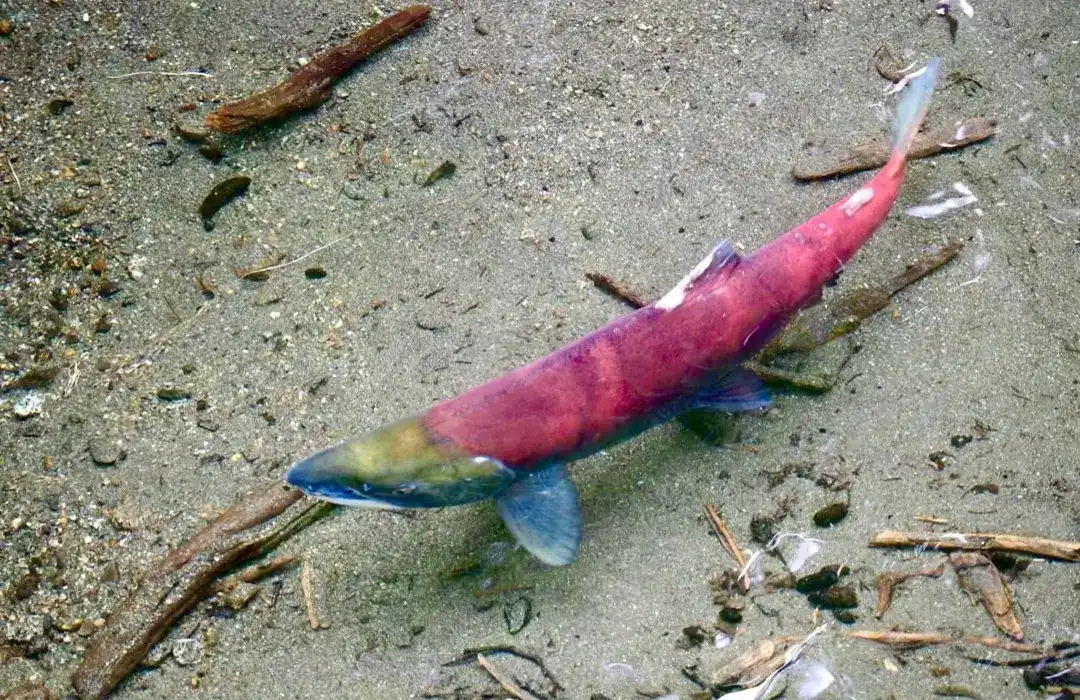
As salmon enter freshwater, their bodies shift from growth toward spawning. Their appearance can change too. In some species, males develop a hooked jaw called a kype, while spawning colours become stronger.
The upstream journey can use a large amount of stored energy. Salmon may swim against strong currents and pass natural or human-made obstacles before reaching suitable spawning habitat.
Timing varies by species and population. Pink salmon, for example, usually return after about 18 months of ocean growth and commonly spawn from August through October, according to NOAA Fisheries. (NOAA Fisheries)
How Does a Female Salmon Build a Redd?
A redd is the gravel nest where a female salmon deposits her eggs.
The female chooses a suitable section of stream or riverbed, turns partly onto her side, and uses strong movements of her body and tail to move gravel and create a depression. NOAA describes this behaviour in its Pink Salmon species guide.
Site quality matters because the eggs remain beneath the gravel while embryos develop. Water needs to move through spaces around the eggs, so they receive oxygen.
Fine sediment can fill those spaces and reduce habitat quality. NOAA notes that excessive sediment can interfere with clean gravel beds needed for salmon eggs.
A redd is therefore more than a hole in the riverbed. It is the first protective habitat for the next generation of salmon.
How Are Salmon Eggs Fertilised?
Salmon use external fertilisation.
When the female releases eggs into the redd, a male releases milt over them. Eggs and sperm meet in the water rather than inside the female.
After fertilisation, the female moves loose gravel over the eggs. Development then continues beneath the streambed. This spawning sequence is documented by both NOAA Fisheries and the National Park Service.
Successful reproduction therefore depends on more than adults simply reaching the same river. Spawning timing, gravel quality, water flow, temperature, and access to suitable habitat all matter.
What Happens to Salmon After They Spawn?
The answer depends on the species.
Pacific Salmon
Pacific salmon such as Chinook, coho, sockeye, pink, and chum generally reproduce once and die after spawning. This reproductive strategy is known as semelparity.
For example, the National Park Service explains that coho salmon are semelparous and die after reproduction.
Their role in the ecosystem does not end immediately. Salmon carcasses can return nutrients and energy to freshwater food webs.
Atlantic Salmon
Atlantic salmon can follow a different pattern.
Some survive spawning and become known as kelts. These fish may remain in rivers or estuaries for a period, move back toward the ocean, recover, and later return to spawn again.
NOAA Fisheries reports that repeat spawning occurs in only a minority of Atlantic salmon.
So, the common statement that “salmon die after spawning” is broadly correct for Pacific salmon, but it should not be applied to every salmon species.
What Happens to the Eggs After Spawning?
Fertilised eggs remain beneath the gravel while embryos develop.
Water temperature affects how quickly development happens. Colder conditions generally lengthen incubation, while warmer water can shorten it within a suitable biological range, according to the National Park Service.
When the eggs hatch, the young salmon are called alevins. They stay close to the redd and live on nutrients stored in an attached yolk sac.
After absorbing the yolk sac, they emerge from the gravel as fry and begin feeding independently.
This is where reproduction connects directly to the next stages of the salmon fish life cycle.
Why Spawning Habitat Matters
A salmon may successfully return from the ocean but still fail to reproduce if suitable spawning habitat is unavailable.
Important conditions include:
- Open migration routes
- Suitable gravel
- Flowing, oxygen-rich water around the eggs
- Appropriate water temperatures
- Low levels of fine sediment
- Connected river, estuary, and marine habitats
Salmon depend on several connected environments throughout their lives. NOAA Fisheries explains how freshwater streams, marine environments, and the adult spawning migration are connected parts of the salmon life cycle.
Protecting salmon reproduction therefore means looking at the wider river system, not only the exact place where eggs are deposited.
FAQs
Do salmon mate for life?
No. Salmon do not form long-term breeding pairs. At spawning grounds, females prepare redds while males compete for opportunities to fertilise eggs.
Do salmon lay eggs in saltwater?
Anadromous salmon normally spawn in freshwater. Their marine phase is mainly associated with feeding, growth, and maturation before adults return to freshwater.
How do salmon know where to spawn?
Many salmon return toward their natal river system. Evidence suggests they may use Earth’s magnetic field for broad navigation and rely more heavily on smell as they approach familiar freshwater.
What is a salmon spawning nest called?
A salmon spawning nest is called a redd. The female digs into the gravel, deposits her eggs, and later covers them.
How many eggs does a salmon lay?
There is no single number for all salmon because egg production varies by species and individual fish.
According to NOAA Fisheries, female sockeye salmon may deposit about 2,000 to 4,500 eggs. NOAA reports around 1,200 to 1,900 eggs for female pink salmon.
Do all salmon die after reproducing?
No. Pacific salmon generally die after spawning, while some Atlantic salmon survive as kelts and may reproduce again.
From Spawning Adult to a New Generation
The reproductive process in salmon transforms the end of one journey for adults into the start of the next generation.
The adults migrate to freshwater streams, where the females construct their redds, while the males fertilize the eggs laid under the stones. Salmon eggs hatch into alevin, after which they become fry.
The reproductive process constitutes a component of the life cycle of salmon. Young salmon move to other developmental stages, namely the parr stage and smolt, before becoming adults.