Salmon Fish Life Cycle: From Egg to Adult
Salmon’s life cycle starts from the egg stage in the freshwater habitat. Eggs develop into young salmon in a streambed, and some of them migrate to the ocean where they spend much time before becoming adult. Mature salmon then go back to the freshwater environment to reproduce.
All these stages entail various physical, behavioral, and environmental modifications in the salmon. Studying all the stages will help one understand the growth process of the fish and their dependence on both freshwater and ocean habitats.
What Are the Main Stages of a Salmon’s Life?
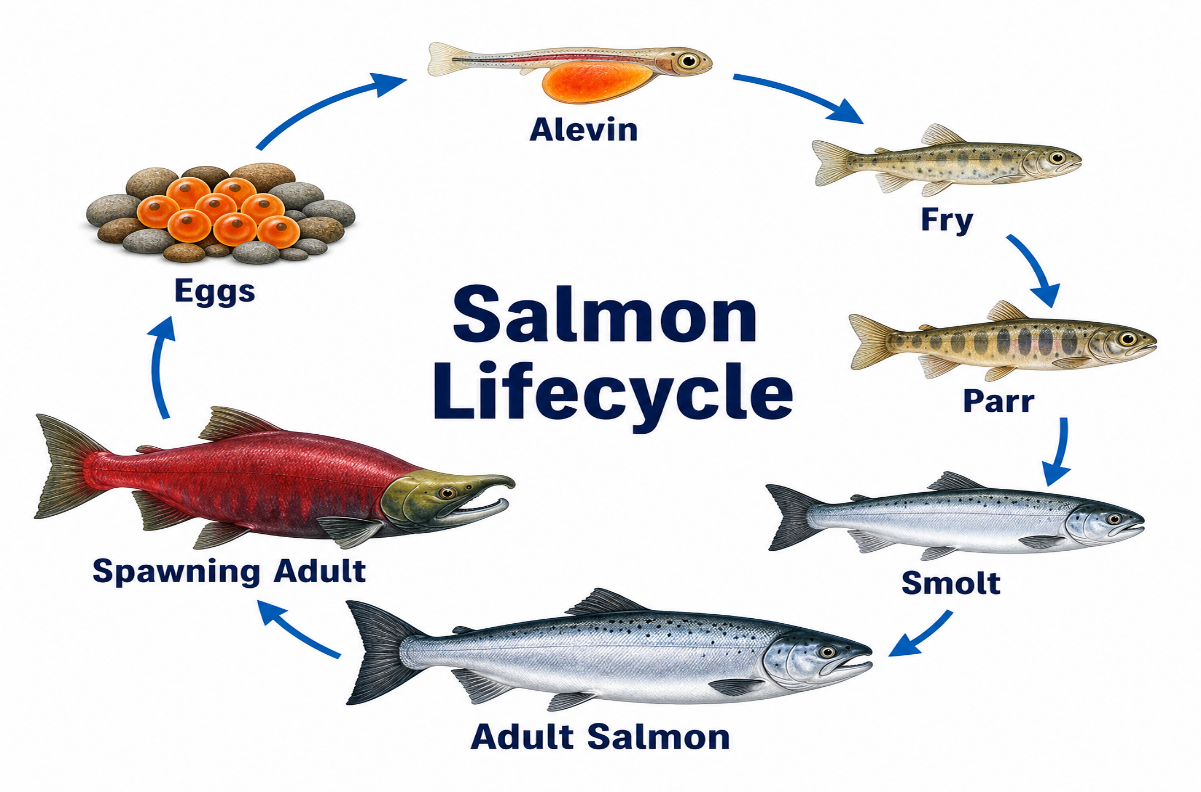
The salmon life cycle has six main stages:
- Egg
- Alevin
- Fry
- Parr
- Smolt
- Adult salmon
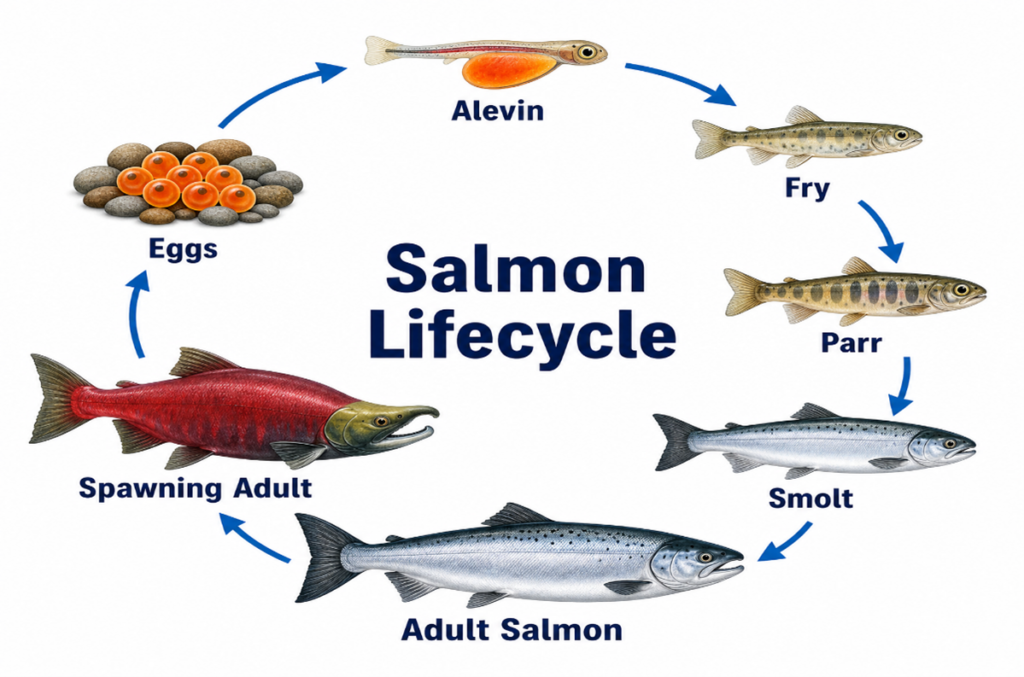
Stage 1: Life Begins Beneath the Stones
Salmon begins life as eggs buried in gravel on the bed of a freshwater river or stream.
A female salmon will dig a pit in the bottom of the river, known as a redd. She will deposit her eggs in this pit, where the male will fertilize them. The eggs will then be covered with gravel.
The egg stage is vulnerable because developing salmon depend heavily on suitable water and gravel conditions.
Developing eggs need clean, well-oxygenated water flowing through the gravel.
Too much fine sediment between the gravel can reduce water flow around the eggs.
The salmon embryo develops inside the egg.
Hatching time for salmon fish eggs
Water temperature affects how quickly salmon eggs develop, although the timing varies among species
Stage 2: The Alevin Stays Hidden
As soon as the egg opens, the baby salmon does not go out into the river.
At this stage, the newly hatched salmon is called an alevin.
The alevin remains attached to its yolk sac, which provides the nutrients it needs during this early stage.
The alevin remains under the gravel while it continues using nutrients from its yolk sac.
The fish doesn’t have to find food; it relies on the yolk sac.
As the yolk sac is absorbed, the young salmon becomes ready to leave the gravel and begin feeding on its own.
Stage 3: Fry Enter the Open Water
When the juvenile fish leaves its gravel habitat and starts to feed by itself, it is known as a fry.
This is the time when it needs to hunt for food all by itself.
The fry can feed on small insects, insect larvae, and other small organisms present in freshwater.
Young salmon may face:
- Larger fish
- Birds
- Strong currents
- Changing water temperatures
- Limited food
- Poor water quality
Vegetation, rocks, logs, pools, and slower-moving water can provide places for fry to feed, rest, and hide from predators.
The habitat is extremely important during this time period.
Stage 4: Fry Grow into Parr
As young salmon grow, many develop dark vertical markings along their sides.
These markings are called parr marks, and salmon at this stage are known as parr.
Parr continue living and feeding in freshwater.
Some may remain in rivers and streams for a relatively short period. Others stay much longer.
Salmon stays as parr depending on several factors including:
- Species,
- population,
- availability of food,
- water temperature,
- habitat.
This is a very significant factor to remember, considering that the life cycle of a salmon does not develop simultaneously for all salmon.
A salmon grows based on its surroundings.
Stage 5: Smolt Prepare for the Ocean
The move toward saltwater brings one of the biggest changes in a young salmon’s life.
Before entering the sea, many juvenile salmon become smolts.
During a process called smoltification, the fish’s body changes so it can cope with saltwater. Its system for controlling salt and water begins working differently, and its appearance may become more silver.
Why is the smolt stage so important?
These changes prepare juvenile salmon for life in saltwater.
These physiological changes allow juvenile salmon to cope with saltwater.
After becoming smolts, they move downstream via rivers and inlets to reach open waters.
For such a small fish, it is the beginning of a very large journey.
Stage 6: Salmon Grow into Adults at Sea
Many salmon grow rapidly after reaching the ocean.
In the ocean, salmon travel widely in search of food that comprises other small fish and crustaceans.
This is also the place where salmon fish grow to become adults.
Some spend more time at sea than others. Different salmon species and populations mature at different rates.
When mature, adult salmon begin migrating back toward freshwater spawning areas.
How Do Salmon Fish Navigate Back to Their Home?
Return migration is one of the most interesting phases in the life of a salmon fish.
Adult salmon migrate from the ocean back toward their natal freshwater rivers.
Researchers know that salmon rely on many different navigational cues during this process. The presence of chemical cues is particularly significant in freshwater, while other forms of navigation aid in covering greater distances.
When they swim upriver, their bodies start changing once again.
Depending on the species, salmon can develop:
- Stronger breeding colors
- Darker skin
- Changes in jaw shape
- More noticeable body features
Their focus has shifted.
They are no longer simply growing and feeding. They are heading toward the final purpose of the journey: reproduction.
Spawning Begins the Next Generation
After the grown-up salmon reach the spawning ground, females dig redds in the gravel where they release their eggs.
After fertilization, the female covers the eggs with gravel.
The entire process begins again:
Egg → Alevin → Fry → Parr → Smolt → Adult → Spawning
Why Is the Salmon Life Cycle So Delicate?
Salmon depends on several different habitats during their life cycle.
Eggs need:
- suitable spawning gravel,
- juveniles need healthy freshwater habitat,
- smolts need open migration routes,
- many adults depend on estuaries and the ocean.
Failure of even one link in this chain may have repercussions on the entire life of a fish.
Challenges may include:
- Habitat loss
- Poor water quality
- Excess sediment
- Blocked migration routes
- Unfavorable water temperatures
- Reduced food availability
- Predation
A Journey That Comes Full Circle
The salmon life cycle begins with a fertilized egg buried in freshwater gravel. As the fish grows, it passes through the alevin, fry, parr, smolt, and adult stages. Many adult salmon eventually return upstream to freshwater spawning grounds, where the next generation begins.
Salmon changes greatly as they move through each stage. They begin feeding independently, grow in freshwater, adjust to saltwater during smoltification, and mature at sea.
Because salmon use several connected habitats, healthy rivers, estuaries, migration routes, and marine environments all contribute to successful reproduction and survival.