
Yelloweye Rockfish Identification, Range & Facts Every Angler Should Know
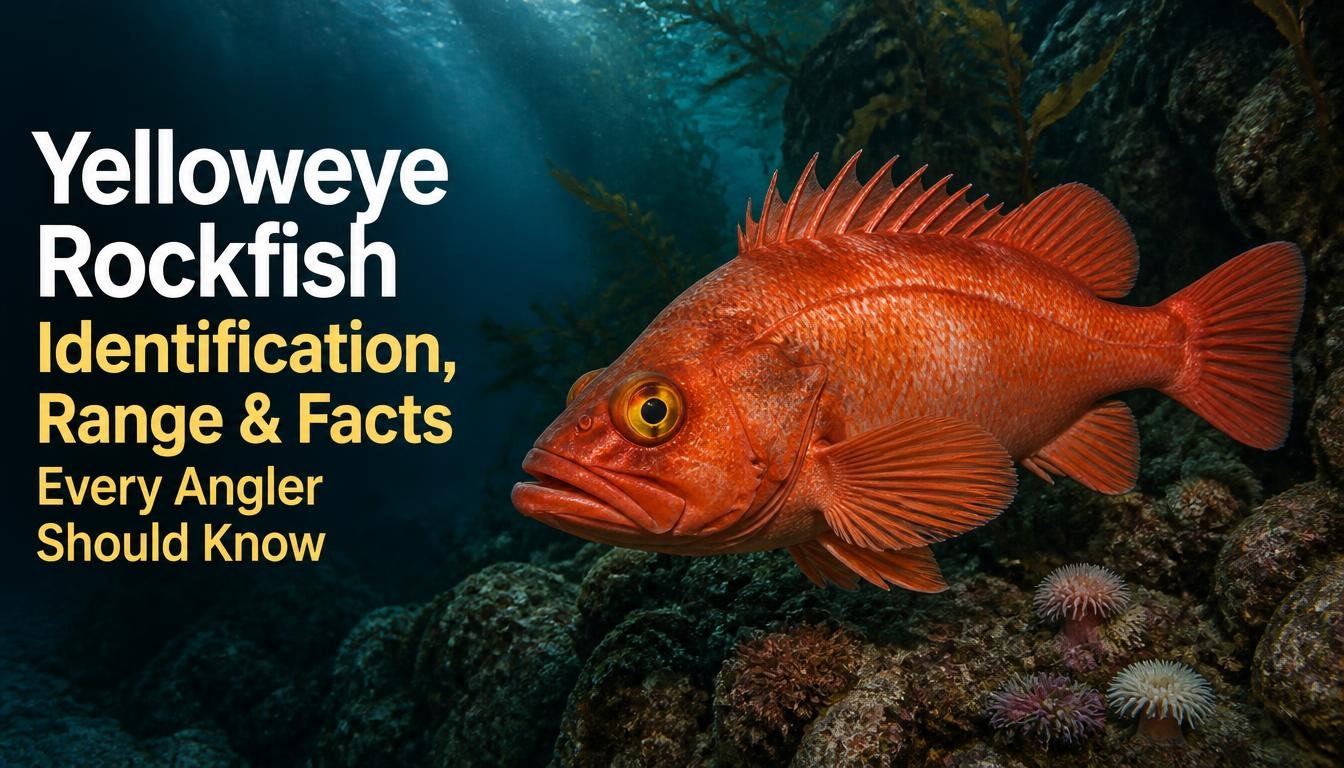
Quick answer: the yelloweye rockfish is a large, long lived Pacific groundfish easily recognized by its bright yellow eyes and deep orange red body. It lives on deep rocky reefs from Mexico to Alaska, can survive up to 150 years, and after being overfished for decades was declared rebuilt on most of the U.S. West Coast in October 2025.
If you fish offshore, run a charter, or just want to know what's on the end of your line when you pull up something bright red with glowing yellow eyes, this guide breaks down everything worth knowing: identification, range, diet, life cycle, and where the rules stand today.
What Is a Yelloweye Rockfish?
Scientifically named Sebastes ruberrimus, the yelloweye rockfish belongs to the huge Scorpaenidae family that dominates rocky bottom fisheries along the Pacific coast. Some anglers and fish markets in the Pacific Northwest call it "red snapper," a nickname that has nothing to do with the actual red snapper caught in the Gulf of Mexico it's simply a local naming habit tied to color, not taxonomy.
Among the region's many rockfish species, yelloweye stands out for three reasons: its color, its size, and its lifespan. Once you've seen one up close, you won't mix it up with anything else on the reef.
How to Identify a Yelloweye Rockfish
Color & Eyes
The name says it all this fish has vivid yellow eyes set against an orange red to rust colored body. That eye color is the fastest, most reliable identifier on the water, since several other rockfish species share a similar red or orange body tone but none carry the same bright yellow eye.
Juveniles Look Almost Nothing Like Adults
Younger yelloweye rockfish are pink to white with two dark stripes across the head and flanks a pattern built for hiding in rocky crevices while they're small and vulnerable. As they grow, the stripes fade and the solid orange red adult coloring takes over.
Fins & Handling
Like other rockfish, yelloweye carry spiny, mildly venomous dorsal spines. If you land one, handle it by the lower jaw or with a lip gripper rather than grabbing across the back a spine puncture stings and can swell for hours.
Size
This is one of the biggest rockfish species you'll encounter. Adults can reach around 90 cm (36 inches) and 11 kg (24 lbs), though the true giants tend to sit deep and old, well below where most recreational gear reaches.
Yelloweye Rockfish vs Look Alike Species
Rockfish identification trips up a lot of anglers because so many species share similar red orange tones. Here's how yelloweye stacks up against two fish it's commonly confused with:
Feature | Yelloweye Rockfish | Vermilion Rockfish | China Rockfish |
Eye color | Bright yellow | Reddish | Dark, not yellow |
Body color | Deep orange red | Bright red/orange | Black with yellow stripe |
Typical adult size | Up to 90 cm | Up to 76 cm | Up to 45 cm |
Max recorded age | ~150 years | ~60–65 years | ~79 years |
Depth range | 90–370+ m | 30–180 m | 10–140 m |
If the fish is large, deep bodied, orange red, and the eyes read distinctly yellow rather than red or orange, you're looking at a yelloweye.
Range: Where Yelloweye Rockfish Are Found
Yelloweye rockfish live exclusively in the northeastern Pacific Ocean you won't find this species anywhere near Pakistan's coastline or the Arabian Sea. Its range runs from northern Baja California, Mexico, north through California, Oregon, Washington, and British Columbia, continuing into the Gulf of Alaska and parts of the Aleutian Islands.
Habitat & Depth Preferences
This is very much a structure oriented fish. Yelloweye rockfish key in on high relief rocky reefs, boulder fields, and rock pinnacles, generally sitting between about 90 and 370 metres of water well beyond typical shallow water tackle for most of the year. Younger fish start out in shallower nearshore rocky habitat and gradually move deeper as they mature, a shift known as an ontogenetic habitat change. That means the small ones you might spot inshore aren't sharing depth with the big, old individuals offshore.
Diet & Feeding Behavior
Yelloweye rockfish are ambush feeders, not active chasers. They hold tight to rocky cover and let prey come to them, feeding mainly on smaller fish such as herring and sand lance, along with shrimp, crabs, and other invertebrates found around reef structure. They're largely solitary and show strong site fidelity meaning the same fish can be found holding on the same piece of structure for years, which is part of why localized overfishing hit specific reef populations so hard.
Life Cycle, Growth Rate & How Long They Live
This is the section that explains almost everything else about the species including why it's been so heavily regulated.
Reproduction
Yelloweye rockfish are ovoviviparous, meaning fertilization happens internally and females give birth to live larvae rather than laying external eggs. A single female can release tens of thousands of larvae per reproductive cycle. The catch: females don't reach reproductive maturity until well into their second decade of life, which is late compared to most harvested fish species.
Growth & Longevity
Yelloweye rockfish grow slowly and live an extraordinarily long time. NOAA Fisheries lists the maximum recorded age at approximately 150 years, making it one of the longest lived fish species documented anywhere. That slow growth, late maturity, and extreme lifespan add up to what biologists call a "K selected" life history a population that builds up very slowly and can take decades, even generations, to recover from heavy fishing pressure.
Conservation Status & Current Fishing Regulations
This is the part every angler actually needs to check before heading out, because the status isn't uniform across the coast.
- U.S. West Coast stock (outside Puget Sound): Declared overfished in 2002, this stock was placed under a strict, long term rebuilding plan with conservative catch limits. It rebuilt faster than projected, and federal managers officially declared it rebuilt in October 2025 opening up new recreational and commercial opportunities in areas that had been closed for over two decades.
- Puget Sound/Georgia Basin population: A separate, genetically distinct population, this one was listed as threatened under the U.S. Endangered Species Act in 2010 and remains under fishing bans in that region. Because of the species' slow growth and late maturity, recovery here is expected to take considerably longer.
Bottom line for anglers: retention rules for yelloweye rockfish differ sharply by state and by specific management area, even within a single state's waters. Always check current NOAA Fisheries and state fish and wildlife regulations for your exact fishing zone before targeting or retaining this species a fish that's legal to keep off the open coast may still be strictly off limits a short distance away in inland waters.
FAQ
What's the easiest way to identify a yelloweye rockfish? Bright yellow eyes on a large, deep orange red body. No other common Pacific rockfish combines that eye color with that size.
Is yelloweye rockfish the same fish sold as "red snapper" in the Pacific Northwest? It's often marketed under that name locally, but it's not the true red snapper species found in the Gulf of Mexico or Atlantic waters the name is a regional habit, not a taxonomic match.
How long can a yelloweye rockfish live? Up to roughly 150 years, according to NOAA Fisheries one of the longest lifespans recorded for any fish species.
Where do yelloweye rockfish live? Only in the northeastern Pacific, from northern Baja California up through the U.S. West Coast, British Columbia, the Gulf of Alaska, and parts of the Aleutian Islands, on deep rocky reef structure.
Can I legally keep a yelloweye rockfish if I catch one? It depends entirely on where you're fishing. The broader West Coast stock was declared rebuilt in October 2025, but the Puget Sound/Georgia Basin population remains protected under the Endangered Species Act with fishing bans in place always check current local regulations first.
What depth do you typically catch yelloweye rockfish at? Adults are usually found between roughly 90 and 370 metres on rocky structure, though younger fish can be found shallower.
What does a yelloweye rockfish eat? Mostly smaller fish like herring and sand lance, along with shrimp and crabs, ambushed from cover near reef structure.
Conclusion
The yelloweye rockfish is one of the most identifiable and most consequential species in Pacific groundfish management. Its yellow eyes make it easy to spot, its 150 year potential lifespan makes it biologically unlike almost anything else you'll catch, and its patchwork conservation status across different regions makes checking local rules non negotiable before you fish for one. For more species you might confuse on the water, see our breakdown of, or browse the full Fish Species library for more identification guides.