
Types of Fisheries Explained: A Complete Guide
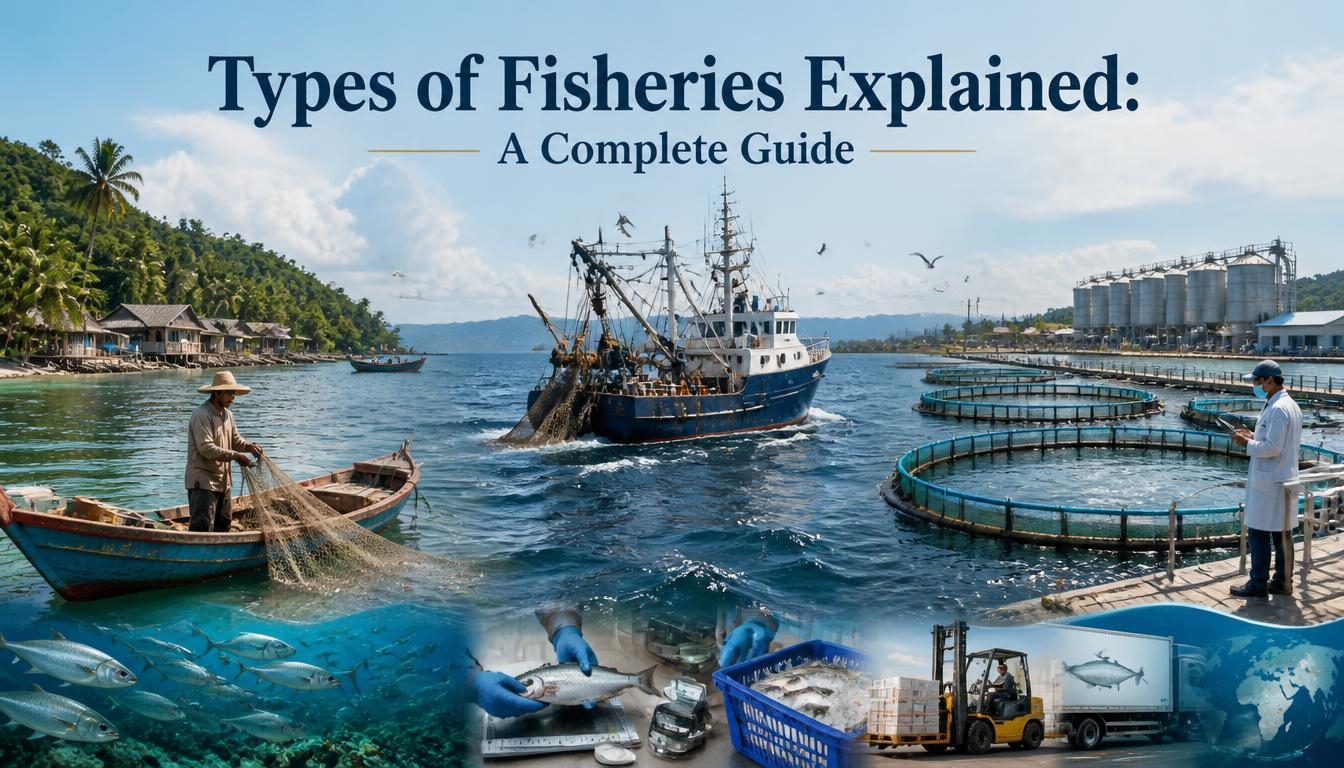
"Fisheries" isn't a single activity it's an umbrella term covering everything from a one person canoe hauling in a local catch to a fully mechanized trawler fleet supplying international seafood markets. Understanding the different types of fisheries matters whether you're a student, a policy reader, or simply curious how the fish on your plate got there. This guide breaks fisheries down by how they're produced, how large they are, why they're operated, and where they take place and explains how fisheries science and fisheries data keep the whole system sustainable.
What Is a Fishery?
A fishery refers to any organized activity involving the harvesting, culturing, or management of aquatic organisms fish, shellfish, and other seafood from a specific water body or region. Fisheries can be marine, freshwater, or brackish, and they subdivide into two broad production methods: capture fisheries (catching wild organisms) and culture fisheries, more commonly known as aquaculture (farming them).
Types of Fisheries by Production Method
Capture Fisheries
Capture fisheries involve harvesting wild fish and other aquatic organisms directly from their natural habitat rivers, lakes, or the ocean. This is what most people picture when they hear "fishing," and it remains a major source of global seafood supply, though its share has been shrinking relative to farmed production.
Culture Fisheries (Aquaculture)
Aquaculture involves raising aquatic organisms under controlled conditions in ponds, tanks, net pens, or cages rather than harvesting them from the wild. Aquaculture has grown rapidly worldwide and, as of recent FAO reporting, now accounts for roughly half of global seafood production, having overtaken capture fisheries in overall output.
Types of Fisheries by Scale
Industrial Fisheries
Industrial (or large scale) fisheries use capital intensive, mechanized vessels equipped with advanced fish finding and navigation technology. They're designed to supply national and international markets at high volume.
Artisanal / Small Scale Fisheries
Artisanal fisheries rely on traditional methods, small vessels, and relatively little capital. Fishing trips are typically short and close to shore, with the catch used for local consumption, though artisanal fisheries can also feed export markets. Definitions vary by country an artisanal fishery might mean a one person canoe in one region and a small trawler under 20 meters in another.
Semi Industrial Fisheries
A middle category between artisanal and fully industrial operations, using moderate levels of mechanization and capital investment more organized than traditional small scale fishing, but without the scale of a major industrial fleet.
Types of Fisheries by Purpose
Commercial Fisheries
Commercial fisheries exist primarily to generate profit catching fish and seafood for sale in domestic or international markets. This category spans both industrial and artisanal operations, as long as the end goal is selling the catch.
Recreational Fisheries
Recreational fisheries are fished for leisure rather than profit. Anglers fishing for sport, whether in freshwater lakes or offshore, fall into this category, and recreational fishing often supports local tourism economies.
Subsistence Fisheries
Subsistence fisheries exist to feed the fishers and their families or communities directly, rather than for sale. This category overlaps significantly with artisanal fishing in many developing regions.
Types of Fisheries by Habitat
Marine Fisheries
Marine fisheries operate in saltwater environments from near shore estuaries, mangroves, and coral reefs to offshore open ocean and seamount fisheries.
Inland / Freshwater Fisheries
Inland fisheries take place in rivers, lakes, ponds, reservoirs, and wetlands. In Pakistan, this includes the Indus River system and its associated lakes and reservoirs, which support both commercial and subsistence freshwater fishing communities.
Brackish Water Fisheries
Brackish water fisheries operate in transitional zones where freshwater and saltwater mix, such as estuaries and coastal lagoons important habitats for many commercially valuable species.
How Fisheries Science and Data Support All of These
Every type of fishery, regardless of scale or purpose, depends on fisheries science to remain sustainable. Fisheries science is an interdisciplinary field that studies fish population dynamics, growth rates, age at maturity, and mortality, combining ecology, statistics, and population dynamics to understand how fish stocks respond to fishing pressure.
This is where fisheries data collection comes in. A fisheries scientist gathers information such as total catch records, stock assessments, and environmental monitoring data, then uses that information to advise on sustainable harvest levels. Fisheries work in this space ranges from hands on field sampling and tagging studies to lab analysis and stock assessment modeling the scientific backbone that keeps capture fisheries and aquaculture operations from collapsing under overharvesting.
Types of Fisheries at a Glance
Classification Basis | Types | Example |
Production method | Capture, Culture (Aquaculture) | Wild caught cod vs. farmed shrimp |
Scale | Industrial, Semi industrial, Artisanal | Trawler fleet vs. one person canoe |
Purpose | Commercial, Recreational, Subsistence | Export seafood vs. weekend angling |
Habitat | Marine, Inland/Freshwater, Brackish | Ocean tuna fishery vs. river fishery |
FAQs
What are the main types of fisheries?
Fisheries are generally classified by production method (capture vs. aquaculture), by scale (industrial, semi industrial, artisanal), by purpose (commercial, recreational, subsistence), and by habitat (marine, inland/freshwater, brackish).
What's the difference between capture fisheries and aquaculture?
Capture fisheries harvest wild aquatic organisms from their natural habitat, while aquaculture (culture fisheries) raises them under controlled conditions such as ponds, tanks, or net pens.
What does a fisheries scientist actually do?
A fisheries scientist collects and analyzes fisheries data catch records, stock assessments, and environmental data to advise on sustainable management. Fisheries work can include field sampling, tagging studies, laboratory analysis, and population modeling.
Why is fisheries science important?
Fisheries science provides the data and population analysis that fisheries managers rely on to set sustainable harvest limits, preventing overfishing across both capture fisheries and aquaculture operations.
Is aquaculture a type of fishery?
Yes. Aquaculture, also called culture fisheries, is one of the two major production method categories alongside capture fisheries, and now accounts for roughly half of global seafood production.
Conclusion
From a subsistence fisher on a small boat to an industrial trawler fleet and a fully controlled aquaculture facility, the types of fisheries in operation today reflect enormous differences in scale, purpose, and habitat but they're all held together by the same underlying discipline: fisheries science. Understanding how fisheries data and fisheries scientists inform sustainable management gives a fuller picture of how the seafood supply chain actually works, from open water to plate.
For more on the ecosystems behind these fisheries, browse our Fisheries & Aquaculture hub, or read our companion guide on Alaska Rockfish: A Species by Species Guide to see how fisheries management plays out for a specific species group.