
Northern Cod: Population, Range & Fishing History
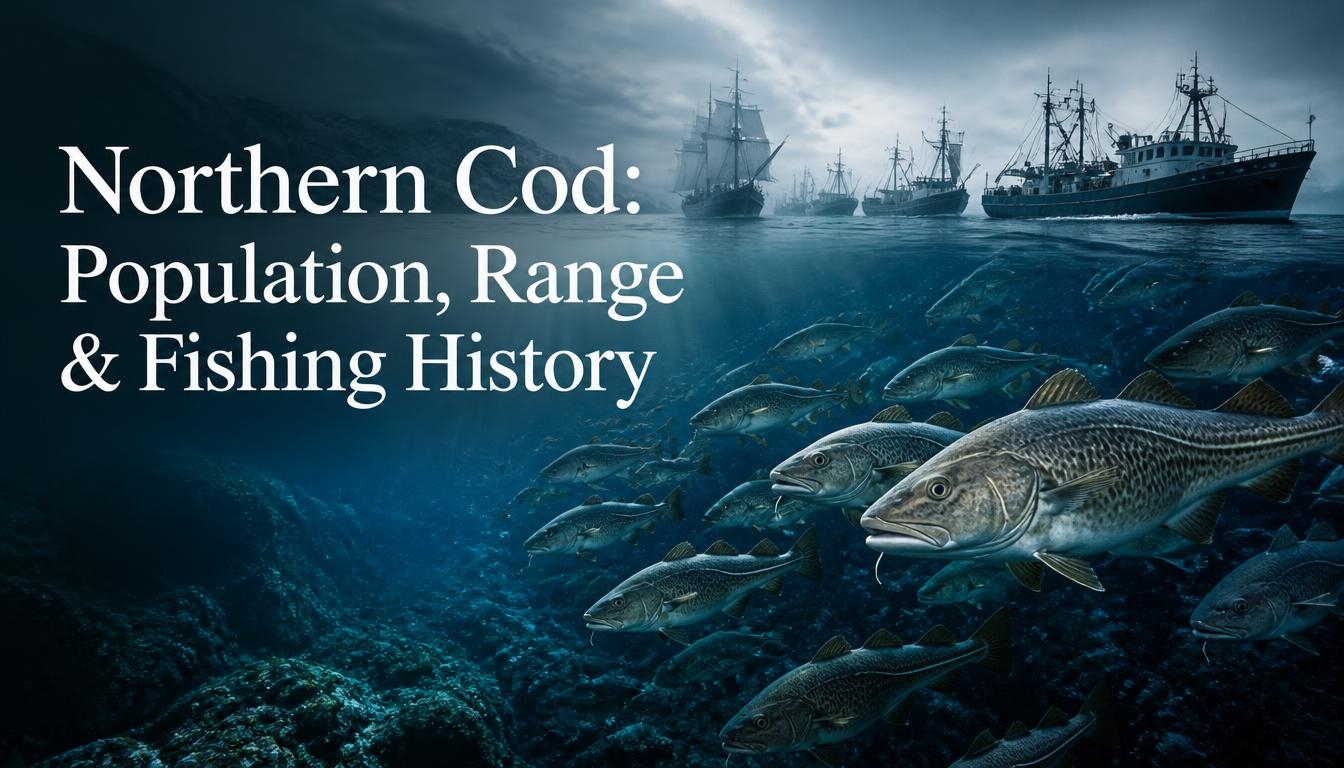
Few fish stocks in the world carry the weight of history that Northern cod does. Its population once numbered in the millions of tonnes, its range spans some of the richest cold water fishing grounds on the planet, and its fishing history stretches back 500 years right up to a collapse so severe it shut down an entire industry overnight. Here is a full look at what Northern cod is, where it lives, how large its population has been at different points in time, and the long fishing history that shaped it.
What Is Northern Cod?
Northern cod isn't a separate species it is Atlantic cod (Gadus morhua), the same true cod found across the North Atlantic, but referring specifically to the stock inhabiting NAFO (Northwest Atlantic Fisheries Organization) divisions 2J3KL, off the coasts of Newfoundland and Labrador. It is this specific population, distinct from other Atlantic cod stocks in Canadian and international waters, that carries the history described below.
Like other Atlantic cod, Northern cod has an elongated body, a greenish brown back with pale spots, a white underside, and the characteristic chin barbel shared by true cod species. Older, larger individuals historically made up a disproportionate share of the spawning population a detail that mattered enormously once fishing pressure began targeting those same larger fish.
Northern Cod Range & Habitat
Northern cod is range centers on the cold, nutrient rich waters of the Grand Banks and the continental shelf off Newfoundland and Labrador an area historically so rich in marine life that it drew fishing fleets from across the Atlantic world for centuries. Within this range, the stock is further defined by NAFO divisions 2J (Labrador Shelf), 3K (Northeast Newfoundland Shelf), and 3L (Grand Bank), together forming the 2J3KL area used in all official Northern cod stock assessments.
Northern cod favor colder bottom water temperatures and are closely tied to the availability of capelin, their primary prey species. Shifts in capelin abundance and ocean temperature across this range have historically tracked closely with changes in cod distribution and health, and continue to influence where the population concentrates today.
A History of the Northern Cod Fishery
European fishing crews were working the Grand Banks for cod as early as the 1500s, and the fishery grew into a cornerstone of Newfoundland and Labrador is economy for generations. For most of that history, catches were sustainable enough to support both local communities and international fleets side by side.
That changed after World War II, when large factory trawlers with far greater range and efficiency began fishing the Grand Banks intensively. Catches surged through the 1960s, and landings in some years reached levels the fishery had never seen before. By 1962, the spawning biomass of Northern cod stood at around 1.6 million tonnes. Total allowable catch by the 1980s had climbed to roughly 240,000 tonnes a year a scale of extraction the population could not sustain indefinitely, even as warning signs began to surface.
Northern Cod Population Decline & Collapse
Decades of intensive fishing from both Canadian and international fleets steadily eroded the Northern cod population, even as catch numbers stayed high or grew. By the early 1990s, the toll became undeniable: the spawning biomass had dropped roughly 93 percent in just 30 years, falling from that 1962 peak of 1.6 million tonnes to somewhere between 72,000 and 110,000 tonnes by 1992.
Several factors combined to drive the population crash:
• Overfishing at an industrial scale factory trawlers could fish harder and deeper than the traditional inshore fleet ever could, removing fish faster than the population could replace itself.
• Removal of older, larger spawners targeting the biggest fish hit the most reproductively valuable part of the population hardest.
• Regulatory gaps quotas existed, but they consistently lagged behind the actual state of the stock, and enforcement across international fleets was inconsistent.
• Scientific uncertainty and delayed action by the time the scale of the decline was fully understood, the population had already crossed into serious trouble.
The 1992 Moratorium and Its Fallout
On July 2, 1992, the Canadian government announced a moratorium on commercial Northern cod fishing a ban intended, at the time, to last around two years while the population recovered. It ended up lasting 32.
The immediate human cost was staggering. Around 30,000 fishers and fish plant workers in Newfoundland and Labrador lost their jobs overnight, representing roughly 12 percent of the province is entire labor force. Including indirect losses across related industries, the total job impact is estimated at closer to 40,000 people. It remains the single largest mass layoff event in Canadian history.
The federal government introduced relief programs, including the Northern Cod Adjustment and Recovery Program (NCARP) and later the Atlantic Groundfish Strategy (TAGS), offering financial assistance and retraining to displaced workers. Over the following decade, Newfoundland and Labrador saw population decline of roughly 10 percent, as workers and families left the province in search of other opportunities. Coastal outport communities that had depended on the fishery for generations struggled to hold together, and some have never fully recovered.
2024: Fishery Reopens
After 32 years, the federal government lifted the commercial Northern cod moratorium, allowing directed fishing to resume across the historic range. The reopening came with a modest total allowable catch increase from 13,000 tonnes in 2023 to 18,000 tonnes alongside a separate 1,000 tonne allocation for international offshore fleets. For context, the pre collapse catch just before the 1992 shutdown was around 240,000 tonnes a year, meaning the reopened fishery represents a small fraction of historical harvest levels.
The decision followed a shift in Northern cod is official stock status in late 2023, when scientific assessment moved the population out of the most critical classification it had held for years. Reaction across the industry was mixed: groups representing seafood producers welcomed the move, while unions representing inshore harvesters pushed back, arguing the population hadn't recovered enough to justify reopening the fishery at all.
Current Population Status & Outlook
The reopening of the Northern cod fishery is best described as cautious rather than a sign of full recovery. The 2024 quota allows roughly 6 percent of the estimated cod biomass to be harvested conservative compared to the pre collapse era, when more than 50 percent of the biomass was taken in some years.
Still, the outlook carries real risk. Technical assessments have put the probability of population decline between 2024 and 2027 as high as 62 to 76 percent, raising the possibility that Northern cod could slide back into the critical zone as soon as 2025. Climate change adds another layer of uncertainty, as shifting ocean temperatures across the stock is range continue to affect both cod and the capelin it depends on for food.
| Pre Collapse (1980s) | 2023 | 2024 (Post Moratorium) |
Total Allowable Catch | ~240,000 tonnes | 13,000 tonnes | 18,000 tonnes |
Share of Biomass Harvested | 50%+ in peak years | N/A (moratorium) | ~6% |
Population Status | Healthy, declining | Critical | Improved, still fragile |
The scientific consensus is that Northern cod is population remains a long way from historical levels, and its future depends heavily on how carefully the reopened harvest is managed across its range in the years ahead.
FAQ
What is Northern cod?
Northern cod refers to the Atlantic cod (Gadus morhua) stock found in NAFO divisions 2J3KL, off the coast of Newfoundland and Labrador one of several distinct Atlantic cod populations in Canadian waters.
Where does Northern cod live?
Northern cod is range covers the Labrador Shelf and the Grand Banks off Newfoundland, favoring cold bottom waters and areas with abundant capelin, its primary food source.
Why did the Northern cod population collapse?
Decades of intensive overfishing by Canadian and international fleets, combined with the removal of large, reproductively important spawning fish and regulatory gaps, drove the spawning biomass down about 93 percent between 1962 and 1992.
When did the Northern cod moratorium end?
The Canadian government lifted the Northern cod moratorium in 2024, after 32 years, allowing a limited commercial fishery to resume with a total allowable catch of 18,000 tonnes.
Has the Northern cod population recovered?
Not fully. While the stock is status has improved enough to justify reopening a limited fishery, scientific assessments still show a high risk of the population declining again in the coming years.
Is Northern cod the same as Atlantic cod?
Yes and no Northern cod is a specific regional stock of Atlantic cod, not a separate species. All Northern cod are Atlantic cod, but not all Atlantic cod belong to the Northern cod stock.
What caused the 1992 mass layoffs in Newfoundland?
The Northern cod moratorium eliminated the region is largest industry overnight, directly costing around 30,000 fishing and processing jobs and triggering broader economic and population decline across the province.