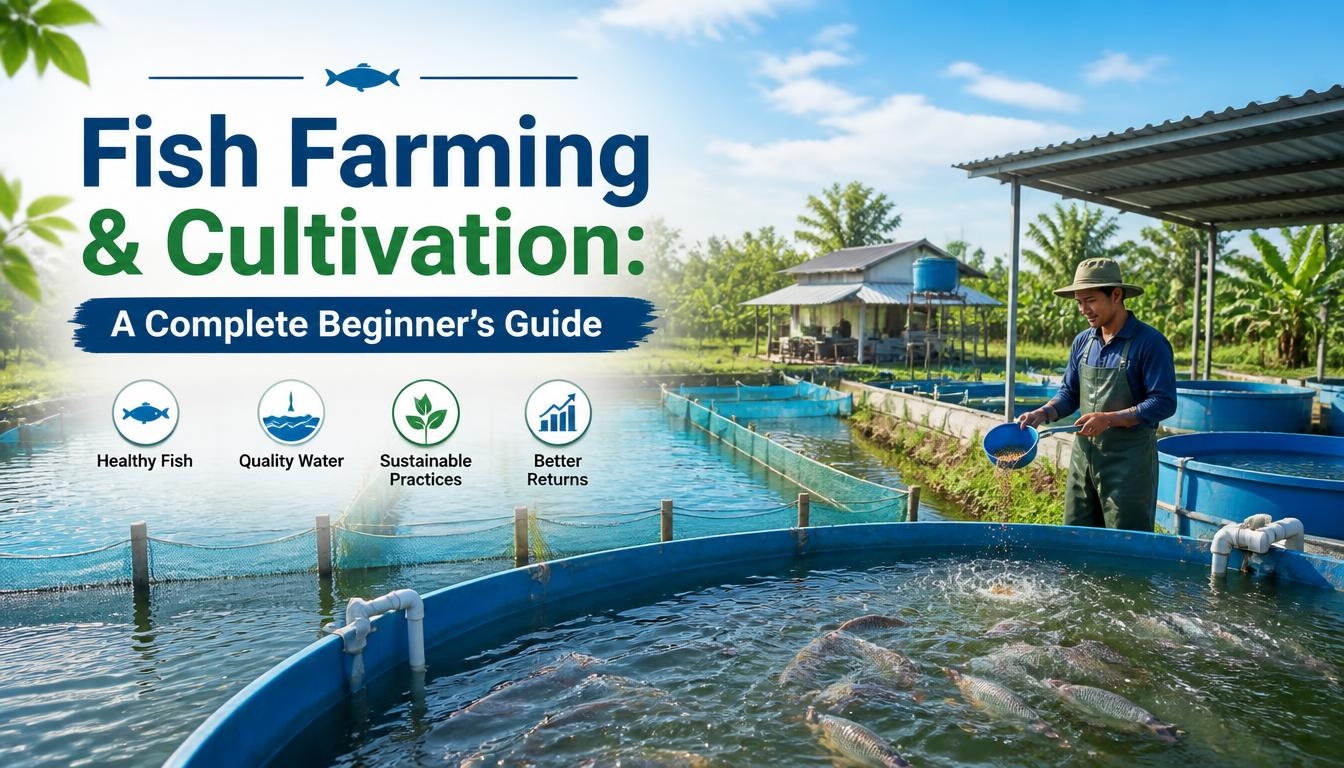
Fish Farming & Cultivation: A Complete Beginner's Guide
Fish now account for nearly half of all the seafood consumed worldwide, and most of that growth is coming from one place: farms, not oceans. Whether you're considering a small backyard pond, a side income stream, or a future commercial operation, the cultivation of fish is one of the most accessible forms of farming to start but also one where a handful of early mistakes can sink an entire season. This guide walks through everything a beginner needs to know: what fish farming actually involves, which systems and species work best when you're starting out, how to set up your first farm, and what it realistically costs.
What Is Cultivation of Fish?
The cultivation of fish, more commonly called fish farming or aquaculture, is the practice of raising fish in controlled environments ponds, tanks, cages, or enclosed systems rather than catching them from the wild. It covers everything from small family run ponds raising a few hundred fish for household consumption, to large commercial operations producing thousands of tonnes a year for export markets.
People take up fish farming for a mix of reasons: it is a reliable source of protein for household food security, an income stream that can be run on relatively small plots of land, and increasingly, a way to meet seafood demand that wild fisheries alone can no longer supply. Globally, aquaculture has grown steadily for decades as wild fish stocks have come under pressure, making cultivation of fish one of the fastest growing segments of food production worldwide.
Types of Fish Farming Systems
Not all fish farming looks the same. The system you choose shapes your costs, your space requirements, and which species will actually thrive.
Pond Culture
The most common and beginner friendly system, especially in regions with access to land and a steady water source. Fish are raised in earthen or lined ponds, often alongside natural feeding sources like algae and plankton, supplemented with commercial feed. Pond culture is relatively low cost to set up and forgiving of minor mistakes, making it the standard starting point for most new farmers.
Cage Culture
Cages or net enclosures are placed directly in existing bodies of water lakes, rivers, or coastal areas allowing fish to grow in a natural water environment while remaining contained for feeding and harvest. This system requires less land investment than ponds but depends heavily on water quality outside the farmer is direct control, and on access to a suitable natural water body.
Recirculating Aquaculture Systems (RAS)
RAS setups raise fish in tanks with water that is continuously filtered and recirculated, rather than replaced. This allows for much higher stocking densities in a small footprint and works in locations without natural water access, but it comes with higher upfront equipment costs and requires more technical monitoring of water chemistry.
Biofloc Systems
A newer approach that uses beneficial bacteria to convert fish waste into an additional food source within the same tank, reducing water exchange needs and feed costs over time. Biofloc systems can be highly productive in a small space but require more hands on management and a learning curve around maintaining the right bacterial balance.
Best Fish Species for Beginners
Species selection matters as much as system selection. Beginners generally do best with hardy, fast growing species that tolerate a range of water conditions and have established local demand.
Species | Growth Time | Water Tolerance | Best For |
Tilapia | 6 to 8 months | High | Ponds, RAS, beginners |
Catfish | 6 to 9 months | High (low oxygen tolerant) | Ponds, high density systems |
Carp | 8 to 12 months | Moderate to high | Ponds, polyculture |
Rohu | 10 to 12 months | Moderate | Ponds, South Asian markets |
Tilapia is the most widely recommended starter species globally due to its fast growth, disease resistance, and tolerance for imperfect water conditions. Catfish is a close second, particularly in pond systems, thanks to its ability to survive in lower oxygen water where other species would struggle. Carp and rohu tend to suit farmers targeting regional or local markets where these species carry stronger existing demand.
Setting Up Your First Fish Farm
Getting the setup right before stocking a single fish saves far more time and money than fixing problems after the fact.
Site and pond selection. Choose a location with reliable access to water, good natural drainage, and soil that holds water well if building an earthen pond (clay heavy soil is ideal). Avoid low lying areas prone to flooding or contamination runoff from nearby farmland.
Water source and quality. A consistent, clean water source is non negotiable whether that is a borewell, river, or municipal supply. Test water for pH (most farmed species do best between 6.5 and 8.5), dissolved oxygen, and ammonia levels before stocking, and periodically afterward.
Pond preparation. New ponds need liming to balance pH and control unwanted organisms, followed by fertilization to encourage natural food sources like plankton before fish are introduced.
Stocking density. Overcrowding is one of the most common beginner mistakes. Stocking density depends on species and system, but beginners should generally stock conservatively in the first cycle and adjust upward as they learn how their specific pond or tank performs.
Feeding and Growth Management
Feed is typically the single largest ongoing cost in fish farming, often 50 70% of total production costs, which makes efficient feeding one of the most important skills to develop early.
Most beginner operations use a combination of natural pond food sources and commercial pelleted feed formulated for the species being raised. Feed should match the fish is size and life stage fry, fingerling, and grow out stages all require different protein levels and pellet sizes. Overfeeding wastes money and degrades water quality as uneaten feed decomposes, while underfeeding slows growth and increases size variation within a stock.
Regular growth monitoring sampling and weighing fish every few weeks helps track whether feed conversion is on target and flags problems early, before they show up as a disappointing harvest.
Common Challenges & Disease Prevention
New fish farmers run into a predictable set of challenges, most of which are preventable with consistent monitoring.
• Water quality decline the most common cause of stress and disease; regular testing catches problems before fish start dying.
• Disease outbreaks often triggered by poor water quality, overcrowding, or introducing infected stock; quarantine new fish and maintain clean equipment.
• Predators birds, snakes, and other wildlife can significantly reduce stock in open pond systems; netting and fencing are standard preventive measures.
• Oxygen depletion particularly at night or during hot weather; aeration equipment is a worthwhile early investment for most pond systems.
• Security and theft a practical but often overlooked risk for farms in accessible or rural locations.
Costs, Profitability & Getting Started
Startup costs vary enormously by system and scale. A small earthen pond operation can start with a modest budget covering pond construction or lining, initial fingerlings, feed for the first cycle, and basic water testing equipment. RAS and biofloc systems cost significantly more upfront due to tanks, pumps, filtration, and aeration equipment, but can produce more fish per square foot over time.
Timeline to harvest typically runs 6 12 months depending on species, meaning most beginners should plan for at least one full cycle before expecting meaningful returns and budget for the possibility that the first cycle is a learning experience rather than a profit driver. Common beginner mistakes that hurt profitability include overstocking, underestimating feed costs, skipping water testing, and scaling up too quickly before mastering a single pond or tank.
FAQ
What does cultivation of fish mean?
Cultivation of fish refers to raising fish in controlled environments like ponds, tanks, or cages, rather than catching them from the wild also known as fish farming or aquaculture.
Is fish farming profitable for beginners?
It can be, but profitability typically takes more than one growth cycle to materialize as farmers learn stocking density, feeding efficiency, and local market demand for their chosen species.
What is the easiest fish to farm for beginners?
Tilapia is widely considered the easiest species for beginners due to its fast growth, hardiness, and tolerance for a range of water conditions.
How much does it cost to start a small fish farm?
Costs vary by system a small pond setup is generally the most affordable entry point, while RAS and biofloc systems require higher upfront investment in tanks and equipment.
How long does it take to raise fish for harvest?
Most beginner friendly species reach harvest size in 6 12 months, depending on the species and growing conditions.
Do you need a license for fish farming?
Requirements vary by country and region, so beginners should check local agricultural or fisheries department regulations before setting up a farm.
What is the difference between aquaculture and fish farming?
Aquaculture is the broader term covering all farmed aquatic organisms, including fish, shellfish, and aquatic plants, while fish farming refers specifically to raising fish.