
Blue Catfish: Species Profile and Fishing Tips
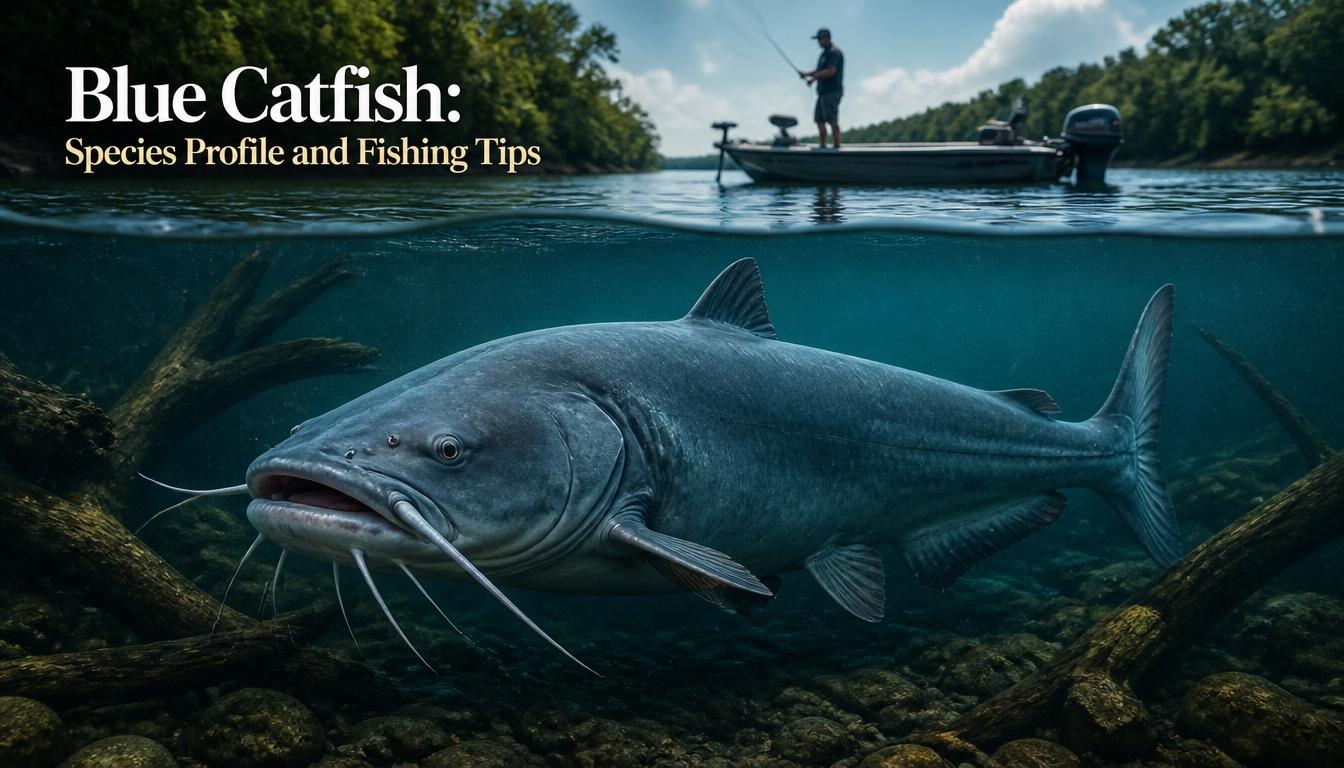
The blue catfish is North America's largest catfish species, capable of growing well past 100 pounds and living for decades in the same river system. It's prized as a trophy gamefish in its native range, treated as a serious invasive problem in others, and consistently confused with the more common channel catfish. This guide breaks down how to identify a blue catfish, where it lives, how big it actually gets, and the fishing tactics anglers use to target it.
Blue Catfish Identification and Classification
Rank | Classification |
Kingdom | Animalia |
Phylum | Chordata |
Class | Actinopterygii |
Order | Siluriformes |
Family | Ictaluridae |
Genus | Ictalurus |
Species | I. furcatus |
Binomial name | Ictalurus furcatus |
Blue catfish have a slate blue to silvery body with a white belly, smooth scaleless skin, a deeply forked tail, and four pairs of black, whisker like barbels around the mouth. The most reliable way to separate a blue catfish from a channel catfish is the anal fin: blue catfish have a straighter edged anal fin with 30 to 36 rays, while channel catfish have a more rounded anal fin with only 24 to 29 rays and often show dark spots on their sides that blue catfish lack.
How Big Do Blue Catfish Get?
Adult blue catfish typically measure less than 2 feet long, but the species can grow to roughly 5 feet (165 cm) and weigh more than 100 pounds. The IGFA all tackle world record stands at 143 pounds, caught in 2011 from Buggs Island Lake (Kerr Lake) on the Virginia–North Carolina border one of the largest freshwater fish ever landed on rod and reel in North America.
Native Range vs. Invasive Range
Blue catfish are native to the Mississippi, Missouri, and Ohio River basins, along with the Rio Grande basin. Starting in the 1970s and 1980s, they were intentionally introduced into several Chesapeake Bay tributaries the James, York, and Rappahannock rivers to create a recreational trophy fishery. The introduction worked almost too well: blue catfish tolerate brackish water and can move freely between rivers and the more saline bay, and their population has since exploded to the point where they're now ranked among the Chesapeake Bay's most concerning invasive species, preying heavily on native shad, herring, blue crab, and even juvenile Atlantic sturgeon.
Diet and Feeding Behavior
Blue catfish are generalist omnivores with one of the broadest diet ranges recorded in any estuarine fish species, according to research on Chesapeake Bay populations. They feed opportunistically on fish, crustaceans, and mollusks, and their willingness to eat almost anything available is a major reason they've been able to establish such dense populations outside their native range.
Lifespan and Reproduction
Most blue catfish live 9 to 10 years, though some individuals have been documented living up to 25 years. Longer lived, larger individuals are typically the ones responsible for trophy class catches, since blue catfish keep growing steadily throughout their lifespan rather than plateauing early.
Fishing Tips for Blue Catfish
- Bait selection: Fresh cut bait shad, herring, or skipjack herring consistently outperforms artificial lures for targeting larger blue catfish.
- Location: Focus on river channels, deep holes, and current breaks where baitfish congregate, especially near the mouths of tributaries.
- Tackle: Use heavy tackle capable of handling fish well over 50 pounds, along with strong circle hooks to improve hook set consistency and support safe catch and release.
- Timing: Warm months typically produce the most consistent action, though blue catfish remain catchable year round in many systems.
- Technique: Drift fishing or anchoring over likely holding areas with bottom rigs are the two most common approaches used by experienced blue catfish anglers.
Is Blue Catfish Safe to Eat?
Yes, in most cases. A Maryland Department of Natural Resources study of Chesapeake Bay blue catfish found mercury levels under 0.47 parts per million and PCB levels between 0.001 and 0.856 ppm in fish up to 41 inches both comfortably under the FDA and EPA's regulatory safety thresholds of 1.0 ppm for mercury and 2.0 ppm for PCBs in commercial seafood. In fact, increased commercial harvest and consumption of invasive blue catfish is actively encouraged in the Chesapeake Bay region as one strategy to help control the population.
FAQs About Atlantic Cod (Gadus morhua)
How do you tell a blue catfish from a channel catfish?
The most reliable field mark is the anal fin: blue catfish have a straighter edged anal fin with 30–36 rays, while channel catfish have a more rounded anal fin with 24–29 rays and often show dark spots that blue catfish lack.
What is the world record for blue catfish?
The IGFA all tackle world record blue catfish weighed 143 pounds, caught in 2011 from Buggs Island Lake (Kerr Lake) on the Virginia–North Carolina border.
Where are blue catfish native to?
Blue catfish are native to the Mississippi, Missouri, and Ohio River basins, as well as the Rio Grande basin; they were later introduced to Chesapeake Bay tributaries, where they're now considered invasive.
What is the best bait for catching blue catfish?
Fresh cut bait particularly shad, herring, or skipjack herring is widely considered the most effective bait for targeting larger blue catfish.
How long do blue catfish live?
Most blue catfish live 9 to 10 years, though the species can live up to 25 years, and the largest, oldest individuals are typically responsible for trophy class catches.
Is it safe to eat blue catfish from the Chesapeake Bay?
Yes testing has shown mercury and PCB levels in Chesapeake Bay blue catfish up to 41 inches remain well under FDA and EPA safety thresholds for commercial seafood.
Conclusion
Blue catfish occupy an unusual middle ground: a genuinely impressive native gamefish capable of trophy class size in the Mississippi, Missouri, and Ohio basins, and a serious ecological problem where it's been introduced into places like the Chesapeake Bay. Whether you're targeting one for sport, considering it for the table, or just trying to identify what you've hooked, the anal fin and forked tail are the fastest way to confirm what's on the end of your line.
For more species anglers regularly target, see our guide to best lake fish species, or explore best freshwater fish for eating if you're planning to cook your catch.