
Pacific Whiting: Species Guide & Where It's Caught
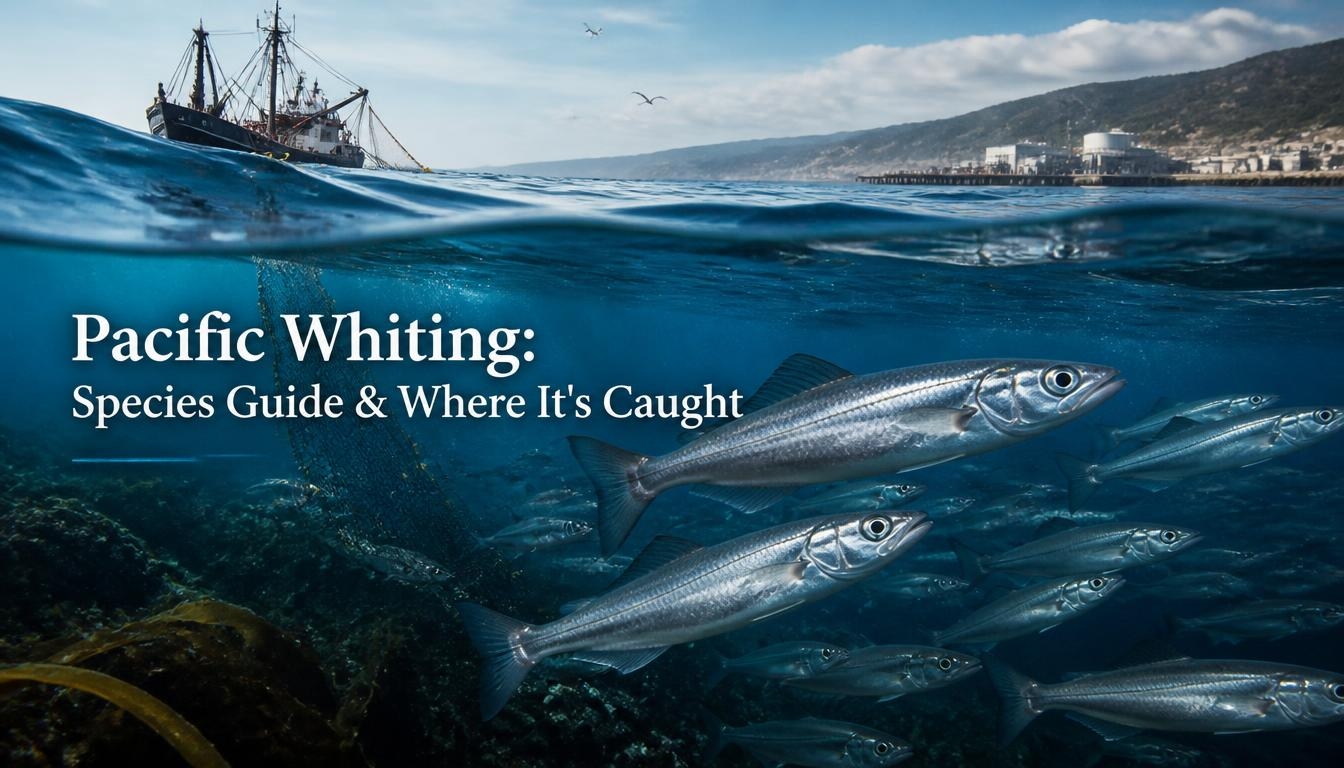
Pacific whiting isn't a fish most people could pick out of a lineup, but there's a good chance they've eaten it it's one of the most heavily harvested groundfish on the entire West Coast, and the backbone of a surimi and fillet industry most consumers never think twice about. This guide is a species deep dive off our West Coast Fishing pillar here's a full look at what Pacific whiting actually is, where it lives, how it's caught, what it becomes once it's processed, and how its fishery is managed.
What Is Pacific Whiting?
Pacific whiting (Merluccius productus), also widely known as Pacific hake, is a slender, silvery groundfish found along the West Coast of North America. It belongs to the hake family, a group of cod like fish, and is easily identified by its elongated body, large eyes, and a slightly protruding lower jaw lined with sharp teeth. Adults typically reach 20 to 24 inches in length, though larger individuals are occasionally caught.
Pacific whiting is a schooling species, often found in large, dense aggregations that make it well suited to commercial trawl fishing. It's also a relatively fast growing, short lived species compared to some other groundfish, reaching maturity within a few years a trait that plays into how its fishery is managed.
Habitat and Range
Pacific whiting ranges along the eastern Pacific from northern Baja California up through British Columbia, with the bulk of the commercially exploited population concentrated off the coasts of California, Oregon, Washington, and southern Canada. The species is known for a pronounced seasonal migration: it spawns off Southern California and Baja California in winter, then migrates north along the coast through spring and summer to feed in the productive waters off Oregon, Washington, and Vancouver Island.
Pacific whiting is a semi pelagic species, meaning it moves between mid water and near bottom depths depending on time of day and season, typically found anywhere from roughly 300 feet to over 3,000 feet deep. This migratory, depth shifting behavior is part of why the fishery is managed jointly between the United States and Canada, since the same population moves through both countries' waters over the course of a year.
How Pacific Whiting Is Caught
Pacific whiting supports the largest groundfish fishery by volume on the West Coast, caught almost exclusively through midwater trawling large net systems towed through the water column to target the dense schools the species forms. The fishery operates through several distinct sectors, including shoreside trawl vessels that deliver to onshore processing plants and at sea processing vessels that catch and process whiting in a single trip.
Recreational catch of Pacific whiting is minimal to nonexistent; it's not a species recreational anglers typically target, and any recreational encounters tend to be incidental rather than intentional. This is overwhelmingly a commercial species, and the fishery's scale reflects that whiting often accounts for a larger catch volume than all other West Coast groundfish species combined in a given year.
What Pacific Whiting Is Used For
The majority of the Pacific whiting catch goes into surimi production the processed, minced fish product used to make imitation crab and other seafood analogs making it one of the most important surimi source species in North America. Beyond surimi, whiting is also processed into fillets, fish meal, and fish oil.
One notable characteristic of Pacific whiting is that it needs to be processed quickly after catch. The species carries a naturally occurring parasite that produces an enzyme causing the flesh to soften rapidly after death, which is part of why so much of the catch goes toward at sea or same day shoreside processing rather than being sold as fresh whole fish. This processing constraint has shaped much of how the fishery itself is structured, favoring vessels and plants built for speed and volume.
Sustainability & Stock Status
Pacific whiting is managed jointly by the United States and Canada under a bilateral agreement, given that the stock migrates across both countries' waters annually. Stock assessments are conducted regularly, and catch limits are set based on the combined assessment of the shared population a notably more coordinated management approach than many single country fisheries.
Compared to a stock like Northern cod, which collapsed under decades of poorly coordinated, under monitored fishing pressure, Pacific whiting's management represents a more proactive model: regular joint assessments, catch limits tied directly to current population data, and a fast growing, short lived life history that makes the species more resilient to fishing pressure than long lived, slow maturing fish. That said, like any actively fished stock, whiting's population still fluctuates year to year based on ocean conditions, and catch limits are adjusted accordingly. For more on how these assessments and catch limits get set in the first place, see our Fisheries Science guide.
FAQ
What is Pacific whiting also called?
Pacific whiting is also commonly known as Pacific hake, and both names refer to the same species, Merluccius productus.
Is Pacific whiting the same as hake?
Yes Pacific whiting and Pacific hake are two names for the same fish, though hake is also used more broadly to refer to other related species in the same family found elsewhere in the world.
Where is Pacific whiting caught?
Pacific whiting is caught primarily off the coasts of California, Oregon, Washington, and southern British Columbia, following its seasonal migration between spawning grounds in the south and feeding grounds in the north.
Is Pacific whiting good to eat?
Yes, though its flesh softens quickly after catch, so most of it is processed into surimi, fillets, or fish meal soon after harvest rather than sold fresh.
Is Pacific whiting sustainably fished?
Pacific whiting is managed under a joint US Canada agreement with regular stock assessments and catch limits tied to current population data, generally considered a well managed fishery relative to many other groundfish stocks.