
Pacific Mackerel: Identification, Range & Facts
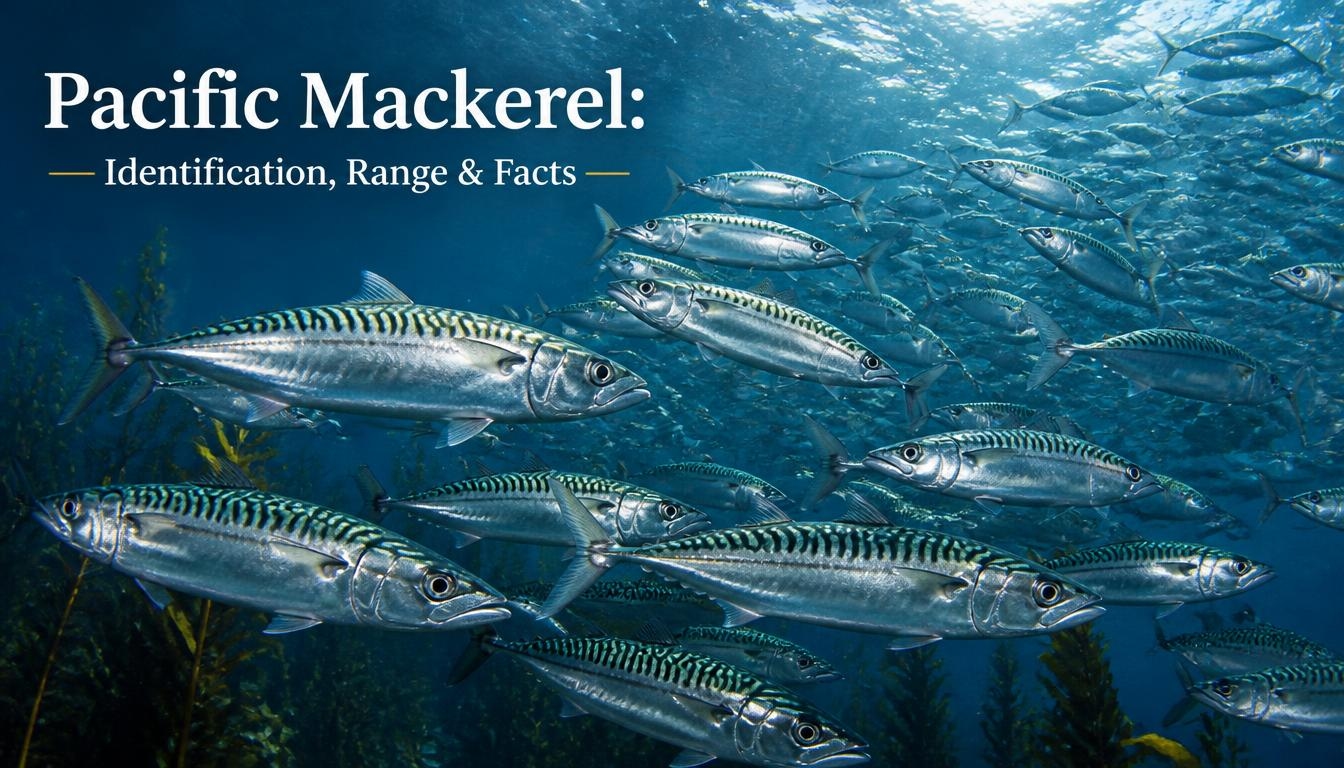
The Pacific mackerel is one of the most abundant fish in West Coast waters, forming massive schools that support much of the coastal food web from British Columbia down to Chile. Also known as the chub mackerel, it's a fast, streamlined member of the tuna and mackerel family, easily identified once you know its distinctive back pattern. This guide covers how to identify Pacific mackerel, where it ranges, and the key facts behind one of the Pacific coast's most ecologically and commercially important fish.
What Is a Pacific Mackerel?
The Pacific mackerel (Scomber japonicus) belongs to Scombridae, the same family as tuna and other true mackerels, and is sometimes called the chub mackerel or Pacific chub mackerel. Despite its modest size compared to family relatives like tuna, it plays an outsized ecological role, forming enormous schools that serve as a critical food source for larger fish, marine mammals, and seabirds throughout its range. It's currently listed as Least Concern by the IUCN, and it supports a long running, actively managed commercial and recreational fishery centered in Southern California.
Identification: Key Features of the Pacific Mackerel
Body Shape and Markings
Pacific mackerel have a classic torpedo shaped, fusiform body built for fast, sustained swimming a hallmark of the tuna and mackerel family. The most distinctive identifying feature is the pattern of dark, wavy, zigzag bars running across the back, set against a silvery blue body that fades to a lighter, almost iridescent silver on the belly.
Fins
Like other members of Scombridae, Pacific mackerel have two separate dorsal fins along the back, followed by a series of small finlets between the second dorsal fin and the tail the same finlet pattern seen on tuna, another clue to its family membership. The tail itself is deeply forked, typical of a fast swimming, open water species.
Size
Most Pacific mackerel caught are relatively small, typically weighing between half a pound and 2 pounds and measuring 10 to 16 inches, though the species can grow considerably larger up to around 6 pounds at maximum size, with sport caught records approaching 7 pounds.
Pacific Mackerel vs Similar Species
Pacific mackerel is sometimes confused with a couple of other schooling fish that share overlapping range and, in one case, part of its common name:
Feature | Pacific Mackerel | Jack Mackerel | Atlantic Chub Mackerel |
Family | Scombridae (tuna/mackerel) | Carangidae (jacks) | Scombridae |
Back pattern | Dark wavy zigzag bars | Plain, no wavy bars | Nearly identical wavy pattern |
Finlets behind dorsal fin | Present | Absent | Present |
Range | Eastern Pacific | Eastern Pacific | Atlantic Ocean |
Despite the shared name, jack mackerel isn't a true mackerel at all it belongs to the jack family (Carangidae) rather than Scombridae, and lacks the small finlets that Pacific mackerel and other true mackerels carry near the tail. Atlantic chub mackerel, by contrast, is genuinely a very close relative, looking nearly identical but occupying an entirely separate ocean basin.
Range & Habitat
Geographic Range
Pacific mackerel ranges along the eastern Pacific from British Columbia south to Chile, though it's most abundant off California and Baja California, where it supports the bulk of the species' commercial and recreational fishing activity.
Depth and Habitat Preferences
This is an open water schooling species, found from the surface down to roughly 300 feet, with a strong preference for water temperatures between about 60°F and 72°F. As ocean temperatures rise seasonally, Pacific mackerel follow warm water northward along the California coast, making the species notably more common off Southern California and Baja in summer and fall than in cooler months.
Diet & Behavior
Pacific mackerel are fast, aggressive schooling predators, feeding on smaller fish, squid, and planktonic crustaceans, and they're known to strike readily at almost any small lure or bait, which makes them a popular and reliable catch for anglers targeting them directly or encountering them as bycatch while fishing for other species. Their tight schooling behavior sometimes forming massive aggregations serves a dual purpose: it improves feeding efficiency and provides some protection from predators, even as it also makes the species an important prey source for larger fish, marine mammals, and seabirds throughout its range.
Life Cycle, Growth & Regulatory Status
Pacific mackerel is managed under the U.S. Coastal Pelagic Species Fishery Management Plan, overseen jointly by the Pacific Fishery Management Council and NOAA Fisheries, alongside California state regulations for the portion of the fishery within state waters. Current federal harvest specifications set the 2025–2026 fishing season (July 2025 through June 2026) harvest guideline at 9,143 metric tons, with an annual catch target of 8,143 metric tons; the following 2026–2027 season carries a higher harvest guideline of 10,448 metric tons. Once the annual catch target is reached, directed fishing for the season closes, with a small set aside reserved for incidental catch in other coastal pelagic species fisheries. This structured, regularly reassessed management approach is a large part of why Pacific mackerel remains a sustainably harvested, Least Concern species despite supporting an active commercial fishery.
FAQ
How do you identify a Pacific mackerel?
Look for a torpedo shaped body with dark, wavy zigzag bars across the back, a silvery belly, two separate dorsal fins, and small finlets between the second dorsal fin and the tail.
Is Pacific mackerel the same as jack mackerel?
No. Despite the shared name, jack mackerel belongs to a different family (Carangidae, the jacks) and lacks the finlets and true mackerel body pattern that Pacific mackerel has.
Where is Pacific mackerel found?
Along the eastern Pacific coast from British Columbia to Chile, most abundantly off California and Baja California, particularly in summer and fall as the species follows warm water northward.
How big do Pacific mackerel get?
Most caught fish weigh half a pound to 2 pounds and measure 10 to 16 inches, though the species can reach up to about 6 pounds at maximum size.
Is Pacific mackerel endangered?
No. It's currently listed as Least Concern by the IUCN and is managed under a structured federal harvest plan with annually set catch limits.
What does Pacific mackerel eat?
Smaller fish, squid, and planktonic crustaceans, caught through fast, aggressive schooling behavior in open water.
Is Pacific mackerel good to eat?
Yes. It has rich, flavorful, flaky dark red flesh and is a good source of protein, omega 3 fatty acids, and several B vitamins, and it's considered a sustainable seafood choice given its actively managed fishery.
Conclusion
Pacific mackerel might not carry the size or spotlight of larger family relatives like tuna, but its role as one of the eastern Pacific's most abundant schooling fish makes it a genuinely important species both ecologically, as a food source throughout the coastal food web, and commercially, as a sustainably managed fishery with annually set harvest limits. Learning its distinctive wavy back pattern and finlet structure is enough to confidently tell it apart from similar looking species like jack mackerel. For more on identifying and comparing West Coast species, see our guide to West Coast fishing.