
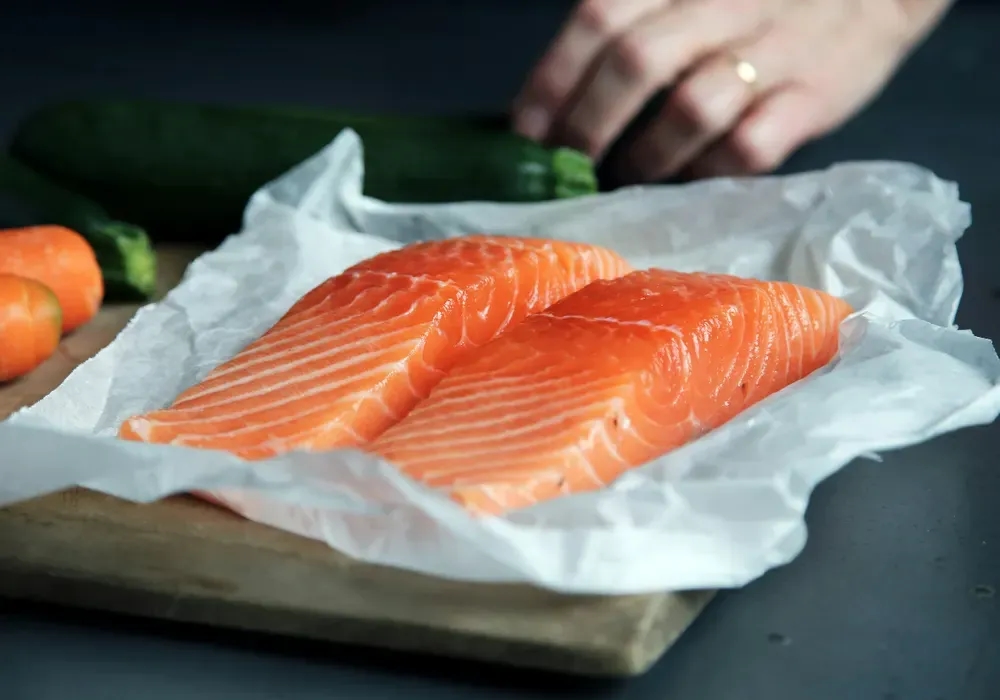
You pick up a salmon fillet that looks bright, glossy, and perfectly pink. The label says “fresh.” The date looks fine.
Still, something makes you hesitate.
That instinct is worth listening to. Fresh Atlantic salmon should pass more than a color test. Smell, firmness, moisture, storage temperature, and the condition of the edges can tell you much more about the fish than a bright orange pink appearance.
Fresh Atlantic salmon should smell mild, feel firm, and look moist without being excessively slimy. The flesh should hold together, with no heavy drying, darkening, or discoloration around the edges. It should also be properly chilled at 40°F (4°C) or below.
Color alone is not a reliable freshness test.
Start With How the Salmon Is Stored
Before comparing individual fillets, look at the seafood display itself.
Fresh fish needs to stay cold. According to the FDA, seafood should be refrigerated or displayed on a thick bed of fresh ice.
Take a quick look at the counter.
- Is the salmon properly chilled?
- Does packaged fish feel cold?
- Is the wrapping intact, without leaking liquid?
If the whole display looks poorly maintained, the brightest fillet in the case is not necessarily your best choice.
A simple rule: proper refrigeration matters more than impressive color.
Use the Look, Smell, and Feel Test
You do not need seafood counter experience to spot many freshness problems.
Three simple checks can tell you a lot.
1. Look at the Flesh, Not Just the Color
Fresh salmon should look moist, firm, and intact.
Avoid fillets with:
- heavily dried edges
- unusual dark or discolored areas
- flesh that looks like it is falling apart
- excessive liquid inside the package
- a thick sticky or slimy coating
Atlantic salmon naturally ranges from pink to reddish orange, so do not judge freshness by how bright the fillet looks.
The FDA notes that fish color can vary because of factors such as diet and environment.
A deeper orange fillet is not automatically fresher than a lighter one.
2. Smell the Salmon
Your nose is one of the most useful freshness checks.
Fresh salmon should smell mild. You may notice a light ocean like smell, but it should not hit you with a strong, unpleasant odor.
The FDA advises avoiding fish that smells:
- sour
- rancid
- strongly fishy
- ammonia like
At a staffed seafood counter, you can ask whether the fish has been recently cut or whether you can check its smell.
With sealed packages, you may not notice a problem until you get home. If the salmon smells sharply unpleasant as soon as you open it, do not assume cooking, seasoning, or lemon juice will make the problem disappear.
3. Check the Firmness
Fresh salmon should hold its shape.
The flesh should look firm rather than loose, mushy, or badly separated. FDA guidance also says fresh fish flesh should spring back when pressed.
Do not press unpackaged fish at the store, of course.
At home, however, texture can provide another clue. If the salmon feels unusually mushy or sticky and also smells questionable, it is safer not to use it.
Check the Edges Before the Center
The center of a salmon fillet often gets all the attention because it is thick, colorful, and attractive.
Look at the edges too.
Thin exposed areas can show drying and deterioration more clearly than the middle of the fillet.
Watch for:
- dry or hardened edges
- darkening
- discoloration
- large gaps between sections of flesh
- excessive surface stickiness
This is particularly useful when buying pre cut supermarket portions.
The center may still look appealing while the edges tell a different story.
Can Fresh Atlantic Salmon Have Been Previously Frozen?
Yes.
A fillet sold from the fresh seafood case may have been frozen earlier in its journey.
That does not automatically mean it is poor quality.
The FDA notes that previously frozen seafood may not show every characteristic associated with fish that has never been frozen, but it should still smell fresh and mild.
What matters is how the fish was frozen, thawed, and stored afterward.
A properly frozen and carefully thawed salmon fillet can still be an excellent choice. Never frozen fish can also lose quality if it spends too much time improperly handled or sitting in a display case.
If you want to know exactly what you are buying, ask:
“Has this salmon been previously frozen?”
That question gives you more useful information than relying on the word “fresh” alone.
Read the Atlantic Salmon Label
Atlantic salmon is the species Salmo salar.
In the United States, Atlantic salmon sold commercially is farm raised because wild Atlantic salmon cannot legally be harvested through commercial or recreational fishing.
NOAA Fisheries also notes that farmed Atlantic salmon is available year round.
When comparing packages, check for:
- species name
- farm raised information
- country or region of origin
- fresh or previously frozen wording
- packed on, sell by, or use by dates
The label cannot prove freshness by itself, but it gives you useful context.
Combine that information with what you can see, smell, and feel.
How Long Does Fresh Atlantic Salmon Last in the Fridge?
Good salmon can quickly lose quality if it gets too warm after you bring it home.
The FDA recommends keeping seafood at 40°F (4°C) or below and using refrigerated seafood within two days.
Once you get home:
- Refrigerate the salmon promptly.
- Keep raw fish away from ready to eat foods.
- Place the package on a plate or tray if it could leak.
- Cook it within the recommended refrigerator window.
- Freeze it if you are not going to use it soon.
How Can You Tell When Salmon Should Be Thrown Away?
Some warning signs become much clearer after you open the package.
Do not use salmon that develops a clearly sour, rancid, or ammonia like odor.
Be especially cautious if that smell appears along with:
- mushy flesh
- excessive slime or stickiness
- major discoloration
- obvious deterioration
Do not taste questionable raw fish to decide if it is still safe.
Freshness checks help you judge quality, but they cannot prove that fish is free from harmful bacteria. Proper refrigeration and safe cooking still matter even when a fillet looks and smells normal.
For food safety, fish should reach an internal temperature of 145°F (62.8°C).
A 30 Second Fresh Atlantic Salmon Check
Need to make a quick decision at the seafood counter?
Run through these checks:
- Cold: Is the salmon properly refrigerated or sitting on fresh ice?
- Smell: Does it smell mild rather than strong or sour?
- Surface: Does it look moist without an excessive slimy coating?
- Texture: Does the flesh look firm and intact?
- Edges: Are they free from heavy drying or discoloration?
- Package: Is it sealed, cold, and free from leaks?
- Label: Does it tell you whether the salmon is fresh or previously frozen?
If several of these checks raise doubts, choose another fillet.
There is usually no good reason to gamble when better looking fish is available nearby.
What About Salmon Fish Health Benefits?
Freshness and nutrition are separate questions, but Atlanticsalmon is also valued for its nutritional profile.
NOAA Fisheries lists farmed Atlantic salmon as a source ofprotein, omega 3 fatty acids, vitamin B12, and selenium.
Those salmon fish health benefits can make it auseful part of a varied diet.
Still, nutrition starts with safe handling. A nutrient richfood does not become safe simply because its nutritional profile is good.
Choose the Fillet, Not the Marketing
The word “fresh” on the sign is useful, but it should not make the decision for you.
Check how the fish is stored. Look closely at the flesh and edges. Pay attention to the smell and firmness. Read the package and find out whether the salmon has been previously frozen.
Those simple checks give you a much better chance of bringing home a fresh Atlantic salmon fillet that is genuinely in good condition, rather than one that simply looked attractive under the seafood counter lights.