
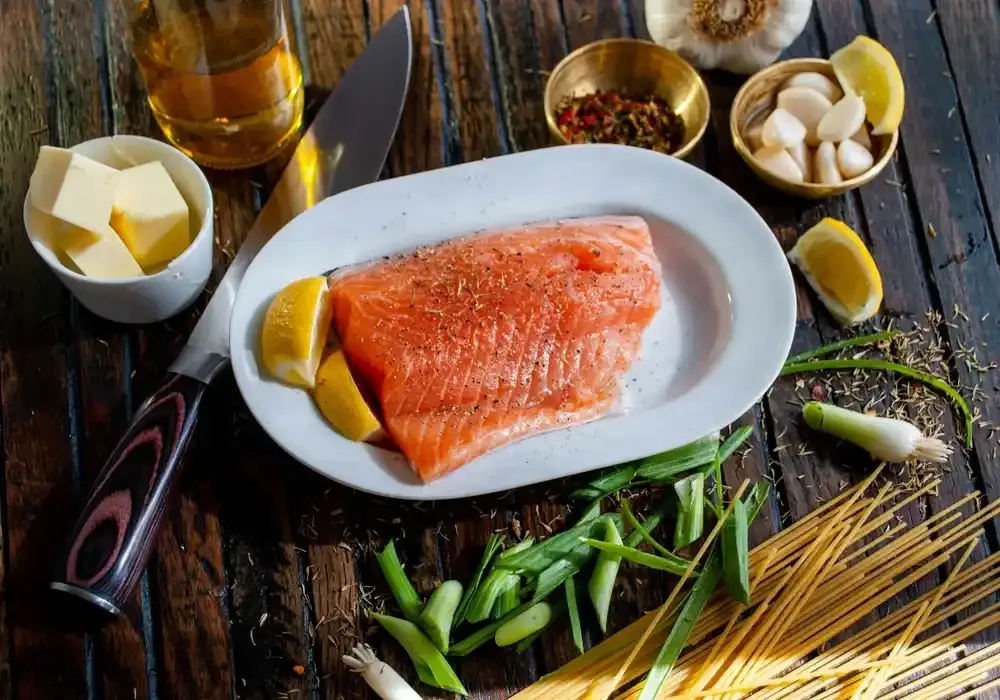
A good fresh Atlantic salmon fillet should smell mild and clean, feel firm, and look moist rather than dry around the edges. Keep salmon refrigerated at 40°F (4°C) or below and cook or freeze it within two days. For food safety, fish should reach 145°F (63°C) at the thickest part.
Buying salmon sounds easy until you stand at the seafood counter trying to choose among several nearly identical fillets.
- One may have brighter color.
- Another may be thicker.
- Some are skin on,
- others are skinless,
- a package labeled “fresh” may even have been frozen before.
You do not need to become a seafood expert to make a good choice.
- Smell,
- firmness,
- thickness,
- storage conditions,
- and the label can tell you far more than color alone.
Here is how to choose a good Atlantic salmon fillet, store it safely, and cook it without drying out a beautiful piece of fish.
What Should Fresh Atlantic Salmon Look and Smell Like?
Start with the smell because it can tell you a lot.
Fresh salmon should have a mild, clean scent. A strong sour, rancid, sharply fishy, or ammonia like odor is a good reason to leave that fillet behind.
The U.S. Food and Drug Administration recommends looking at several freshness signs rather than judging seafood by appearance alone.
Color can still be useful, but do not let a bright pink fillet make the decision for you.
Before buying salmon, check:
- Smell: Mild and clean, not sour or ammonia like.
- Texture: Firm rather than soft or mushy.
- Surface: Moist without looking slimy or excessively dry.
- Edges: Free from obvious drying or heavy discoloration.
- Display: Properly refrigerated or placed on clean ice.
- Packaging: Cold, sealed, and free from leaks or damage.
If the smell seems wrong, skip it. Cooking does not make spoiled fish fresh again.

How to Pick the Right Salmon Fillet
The best cut depends on what you plan to do with it.
For baking, roasting, or grilling, a thick center cut piece is usually easier to handle. Its more even thickness helps the fish cook at a similar rate from one side to the other.
Thin tail sections are different. They cook quickly and can work well for fast skillet meals, but they also dry out faster if you lose track of them.
When buying several portions for the same meal, look for pieces with similar thickness. That makes it much easier to have everything ready at the same time.
Quick Guide to Salmon Cuts
Fillet Type | Works Well For |
|---|---|
Thick center cut fillet | Baking, roasting, grilling |
Thin tail section | Quick pan cooking |
Skin on fillet | Pan searing, grilling |
Skinless fillet | Pasta, rice bowls, salads, tacos |
Should You Buy Skin On or Skinless Salmon?
Neither option is automatically better.
Choose skin on salmon when you want crispy skin or plan to cook the fish in a pan or on the grill. The skin also creates a barrier between the flesh and the direct heat, which can make the fillet a little more forgiving while it cooks.
Skinless salmon makes more sense when the fish will eventually be broken into pieces.
It works particularly well in:
- Pasta
- Rice bowls
- Salads
- Tacos
- Sandwiches
Think about the finished dish rather than treating skin on versus skinless as a quality issue.
Fresh vs. Previously Frozen Salmon
The word “fresh” can be misleading.
Salmon sold at a seafood counter may be fresh or previously frozen. According to the FDA, previously frozen fish may have slightly different characteristics from fish that has never been frozen, but it should still smell mild and fresh when sold.
So, does never frozen salmon automatically taste better?
Not necessarily.
If you plan to cook the fish immediately and specifically want salmon that has never been frozen, ask the seafood counter staff before buying.
But properly frozen and carefully thawed salmon can still be an excellent choice.
In fact, a well handled previously frozen fillet may be a better buy than a supposedly fresh piece that has been sitting in the display case for too long.
The more useful question is not simply, “Was it frozen?”
Ask yourself, “Has this fish been handled properly?”
Is Atlantic Salmon Farmed or Wild?
This label causes plenty of confusion.
Atlantic salmon is the species Salmo salar. In the United States, commercially available Atlantic salmon is farm raised because commercial and recreational fishing for wild Atlantic salmon is prohibited.
NOAA Fisheries describes farmed Atlantic salmon as available year round and notes its rich flavor, firm texture, and relatively high fat content.
That means seeing “Atlantic salmon” on a supermarket label does not mean the fish was caught wild somewhere in the Atlantic Ocean.
Check the package instead.
Useful information to look for includes:
- Species
- Farm raised or wild caught status
- Country or region of origin
- Fresh or previously frozen status
- Package and date information
Your final choice may come down to flavor, price, availability, and what you plan to cook.
How to Store Fresh Atlantic Salmon
Once you bring salmon home, keeping it cold becomes the priority.
The FDA recommends keeping seafood at 40°F (4°C) or below and using refrigerated seafood within two days.
If you know you will not cook it within that period, freeze it instead of letting it sit in the refrigerator for several extra days.
Simple Salmon Storage Guide
Storage Situation | What to Do |
|---|---|
Refrigerator temperature | Keep at 40°F (4°C) or below |
Fresh salmon in the fridge | Use within 2 days |
Freezer temperature | Keep at 0°F (-18°C) or below |
Not cooking it soon | Freeze it promptly |
A few simple habits can also help:
- Keep the salmon cold while traveling home from the store.
- Refrigerate it as soon as you arrive.
- Store it in one of the colder areas of the refrigerator.
- Keep raw salmon separate from cooked and ready to eat foods.
- Place the package on a plate or tray in case liquid leaks.
- Freeze it if your dinner plans change.
Raw fish also should not sit on the kitchen counter while you prepare everything else.
The FDA advises keeping perishable foods at room temperature for no more than two hours, or one hour when temperatures are above 90°F.
Can You Freeze Fresh Atlantic Salmon?
Yes.
If you will not cook your salmon within the recommended refrigerator window, freezing is usually the smarter choice.
Wrap or seal the salmon well so as little air as possible reaches the surface. Good packaging helps protect the quality of the fish while it is frozen.
When you are ready to use it, thaw the salmon in the refrigerator rather than leaving it on the counter.
And remember: freezing can preserve salmon that is still in good condition, but it cannot restore freshness to fish that has already started deteriorating.
Is Atlantic Salmon Nutritious?
Atlantic salmon brings more to the plate than its rich flavor.
According to NOAA Fisheries, farmed Atlantic salmon provides nutrients including:
- Protein
- Omega 3 fatty acids
- Vitamin B12
- Selenium
What Is the Best Way to Cook Atlantic Salmon?
There is no cooking method that wins every time.
The best way to cook salmon depends on the cut, whether the skin is on or off, and how hands on you want to be while cooking it.
Here is the simple version:
Cooking Method | Best For | What to Watch |
|---|---|---|
Pan searing | Skin on portions | Dry the surface first for better browning |
Baking | Thick fillets | Thickness affects cooking time |
Grilling | Thick or skin on portions | Thin pieces can cook very quickly |
Air frying | Small portions | Check early to avoid overcooking |
Pan Searing
Pan searing is especially useful when you have skin on salmon and want a crisp exterior.
Pat the salmon dry before it touches the pan. Excess surface moisture creates steam, which works against browning.
For skin on salmon, place the skin side down first and let it cook without constantly moving the fillet.
Once it is ready to turn, flip it carefully.
Salmon is delicate. Repeated flipping usually does more harm than good.
Baking
Baking works particularly well with thicker fillets because the heat surrounds the fish more gently than direct stovetop cooking.
Seasoning can stay simple.
Try combinations of:
- Lemon
- Garlic
- Black pepper
- Fresh herbs
- Olive oil
- A mild spice blend
Pay more attention to the thickness of the fillet than to a fixed recipe time. A thin tail piece can finish well before a thick center cut portion.
Grilling
Grilling gives salmon a deeper roasted flavor and works especially well with sturdy, thicker portions.
Skin on fillets are also easier to manage on the grill because the skin gives the flesh some protection from direct heat.
If you are new to grilling fish, start with a thicker piece rather than a thin tail section.
It gives you a little more room for error.
Air Frying
An air fryer is convenient when you are cooking smaller salmon portions and want dinner on the table quickly.
The circulating hot air cooks efficiently, which is useful—but it also means thin portions may finish sooner than expected.
Check the salmon early instead of relying entirely on the timer.
How Long Should Salmon Cook?
This is one place where a universal answer causes more problems than it solves.
A thin tail section and a thick center cut fillet simply do not cook at the same speed.
Cooking time changes depending on:
- Fillet thickness
- Portion size
- Cooking method
- Starting temperature
- Your individual oven, pan, grill, or air fryer
What Temperature Should Salmon Reach?
For food safety, fish should reach 145°F (63°C) at its thickest point.
Both the FDA and USDA use 145°F as the recommended safe minimum temperature for fish. Use a food thermometer in the thickest section of the fillet.
Some chefs and recipes recommend lower temperatures to produce salmon with a softer or more translucent center.
That is a preference for doneness.
It is not the federal recommended safe minimum temperature.
If food safety is your priority, follow the 145°F (63°C) recommendation.
Common Salmon Mistakes That Ruin a Good Fillet
You can start with excellent salmon and still end up disappointed if a few small things go wrong in the kitchen.
- Choosing Salmon by Color Alone
- Putting Wet Salmon Straight Into the Pan
- Cooking Thin and Thick Pieces Together
- Moving the Salmon Around Too Much
- Overcooking It
- Guessing Whether It Is Done
- Leaving Raw Salmon Out Too Long
- Using Too Much Seasoning
A Simple Way to Buy Better Salmon
You do not need to overthink the seafood counter.
Look for salmon that smells mild, feels firm, looks moist, and has been kept properly chilled. Then choose a cut that suits the way you plan to cook it.
Once you get home, keep the fish cold and either cook or freeze it within the recommended storage period.
A good fresh Atlantic salmon fillet does not need complicated treatment. Choose it carefully, keep the seasoning simple, and give the fish a chance to be the star of the meal.