
50 Fun Facts About Fish You Probably Didn't Know
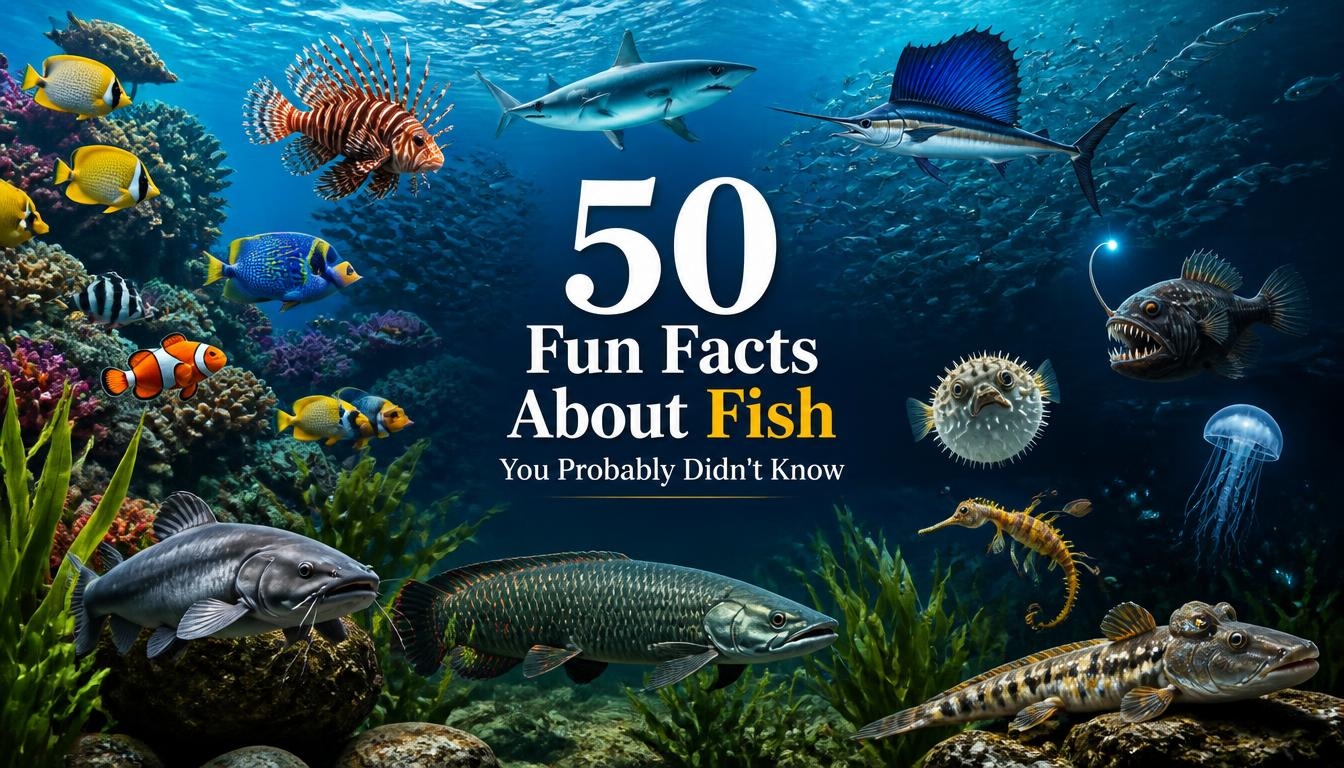
Looking for genuinely surprising fun facts about fish? Fish are the most diverse group of vertebrates on the planet, with more than 34,000 known species which means the weirdest, fastest, oldest, and strangest facts in the animal kingdom are hiding somewhere in the water. Below are 50 fish fun facts covering anatomy, speed records, intelligence, bizarre adaptations, reproduction, and a few facts closer to home in Pakistan.
Anatomy & Senses
- Catfish don't just taste with their mouths their entire body is covered in taste buds, including their skin and fins, letting them "taste" the water around them.
- Some fish, like the four eyed fish (Anableps), have eyes divided into two parts so they can see above and below the water's surface at the same time.
- Sharks have been around in some form for over 400 million years, predating trees by tens of millions of years.
- Antarctic icefish produce natural antifreeze proteins in their blood, keeping them from freezing solid in sub zero polar water.
- Fish don't have eyelids in the way mammals do, which is why it can look like they never blink or sleep but many fish do rest, just with their eyes open.
- A fish's lateral line a row of sensory organs along its sides lets it detect vibrations and pressure changes in the water, effectively "feeling" objects and other fish nearby without touching them.
- Seahorses have no stomach at all; food passes through their digestive system so quickly that they must eat almost constantly to survive.
- Some deep sea fish, like anglerfish, produce their own light through bioluminescence, using it to lure prey in the pitch black depths.
- Parrotfish have beak like fused teeth strong enough to bite off and grind chunks of coral, and a single parrotfish can produce hundreds of pounds of sand like waste a year from digested coral.
- Pufferfish inflate by rapidly gulping huge amounts of water, expanding to several times their normal size to deter predators.
Speed, Size & Record Breakers
- The sailfish is widely cited as the fastest fish in the ocean, popularly reported at speeds up to around 68 mph, though newer studies using more rigorous tracking methods suggest its actual sustained swimming speed is considerably lower.
- The whale shark is the largest fish in the world, growing beyond 40 feet long and weighing more than 15 tons despite its size, it feeds mainly on plankton.
- The black marlin is one of the strongest pulling fish targeted by anglers, with some tracked bursts estimated at well over 40 mph.
- The smallest known fish species, a type of stout infantfish, measures less than a centimeter as an adult.
- Bluefin tuna can weigh over 1,000 pounds and are capable of short high speed bursts while hunting, making them one of the ocean's most powerful predators.
- The Greenland shark is the longest living vertebrate known on Earth, with scientists estimating some individuals live over 270 years, and possibly beyond 500.
- Sturgeon can grow to enormous sizes and live for over 100 years, making them among the longest lived freshwater fish species.
- The ocean sunfish (Mola mola) can weigh over 2,000 pounds, making it one of the heaviest bony fish species in the world.
- Some species of rockfish, including yelloweye rockfish, can live well beyond 100 years one of the longest lifespans documented in any bony fish.
- Flying fish can glide above the water's surface for distances of over 600 feet, using enlarged, wing like fins to escape predators.
Behavior & Intelligence
- Cleaner fish, like certain wrasses, run "cleaning stations" where larger fish line up to have parasites picked off their skin a genuine cooperative relationship rather than predation.
- Archerfish can spit a precisely aimed jet of water to knock insects off overhanging branches into the water, then eat them.
- Clownfish are immune to the stinging cells of the sea anemones they live in, thanks to a protective mucus coating, letting them shelter safely inside tentacles that would sting other fish.
- Some fish species, including certain cichlids, have demonstrated the ability to recognize individual human faces in lab studies.
- Goldfish have a longer memory than the popular "three second memory" myth suggests studies show they can retain learned information for months.
- Groupers and moray eels have been observed hunting cooperatively, with the grouper signaling the eel to help flush prey out of reef crevices.
- Salmon can find their way back to the exact river where they hatched, years later, largely by detecting the unique chemical scent of that specific stream.
- Mudskippers can breathe air and move across land using their fins almost like limbs, spending significant time out of water entirely.
- Some catfish species have been observed beaching themselves temporarily to snatch pigeons and other birds resting near the water's edge.
- Electric eels can generate shocks of several hundred volts, strong enough to stun prey or deter predators, using specialized electricity generating cells along their body.
Weird & Wonderful Adaptations
- The mangrove rivulus, a small killifish, can survive out of water for weeks by breathing through its skin and hiding in damp logs.
- Lungfish can survive extended droughts by burrowing into mud and breathing air directly through a modified lung like organ.
- Some fish, like certain wrasses and clownfish, can change sex over their lifetime depending on social conditions within their group.
- The frogfish can walk along the seafloor using its fins almost like legs, rather than swimming in open water.
- Certain deep sea fish have transparent, barely visible bodies, an adaptation that helps them avoid predators in a habitat with almost no light to hide in.
- The hagfish, an eel like fish, defends itself by releasing large amounts of slime almost instantly when threatened, clogging the gills of would be predators.
- Some species of gobies can climb waterfalls using suction cup like fins to attach themselves to wet rock as they move upstream.
- The blobfish, often mocked online for its droopy appearance out of water, actually looks fairly ordinary in its natural deep sea habitat, where water pressure supports its gelatinous body.
- Certain fish species, like the four eyed fish, live at the surface with half their body above water and half below almost permanently.
- Anglerfish males are often dramatically smaller than females and, in some species, permanently fuse to a female's body, surviving as little more than an attached sperm source for the rest of their lives.
Reproduction, Lifespan & Family Life
- Seahorses are one of the only animal groups where the male, not the female, carries the developing offspring, in a specialized pouch until they're born.
- Most rockfish species give birth to live young rather than laying eggs, a reproductive strategy called ovoviviparity shared across the entire rockfish family.
- Salmon undertake one of the animal kingdom's most demanding migrations, swimming from the ocean back up freshwater rivers to spawn, sometimes traveling hundreds of miles against the current.
- European eels migrate thousands of miles to the Sargasso Sea to spawn, a journey scientists only partially understand even today.
- Some fish species can produce well over a million eggs in a single spawning event, though only a small fraction typically survive to adulthood.
- Certain species of tilapia are mouthbrooders, meaning parents carry fertilized eggs and even hatched fry inside their mouths to protect them from predators.
- A single female rockfish can release tens of thousands of live larvae in one reproductive cycle rather than laying external eggs.
- Bettas (Siamese fighting fish) build bubble nests at the water's surface, where males guard fertilized eggs until they hatch.
- Some catfish species are known to reach sexual maturity only after a decade or more, contributing to their notably long overall lifespans.
- Fish diversity worldwide is staggering with more than 34,000 recognized species, fish make up roughly half of all known vertebrate species on Earth.
Fish Facts Closer to Home: Pakistan Edition
- The mahseer, sometimes called the "tiger of the water" among South Asian anglers, is a prized freshwater game fish found in the Indus River system and can grow to substantial sizes.
- Hilsa (Tenualosa ilisha), a culturally significant fish across South Asia, migrates from the sea into freshwater rivers to spawn, similar in behavior to salmon.
- Pakistan's carp farming industry depends on a polyculture system, stocking several carp species together in the same pond so each can feed at a different level of the water column.
- Trout were introduced to the cold water streams of northern Pakistan, including Chitral, Swat, and Gilgit Baltistan, where they've become an established part of local freshwater fisheries.
- Fisheries in rivers and reservoirs account for more than 80 percent of Pakistan's total inland fish production, with the Indus River system at the center of the country's freshwater fishing industry.
FAQ
What is the fastest fish in the world?
The sailfish is popularly cited as the fastest, with figures around 68 mph, though more rigorous modern tracking studies suggest its true sustained speed is likely lower than the classic claim.
What is the largest fish in the world?
The whale shark, which can grow beyond 40 feet long and weigh more than 15 tons, despite feeding mostly on tiny plankton.
What is the longest living fish?
The Greenland shark holds the record among vertebrates generally, with some individuals estimated to live over 270 years and possibly beyond 500, based on scientific dating studies.
Do fish sleep?
Many fish do rest, but because most lack eyelids, it can look like they never close their eyes they typically slow down and become less active rather than sleeping the way mammals do.
Can fish really change sex?
Yes. Several species, including some wrasses and clownfish, can change sex during their lifetime depending on the social structure of their group.
How many species of fish exist?
More than 34,000 recognized species, making fish the most diverse group of vertebrates on the planet.
What fish are important in Pakistan specifically?
Carp dominates Pakistan's aquaculture industry, while the mahseer and hilsa are notable wild species with strong cultural and recreational significance in the Indus River system.
Conclusion
From a shark that can live for centuries to a fish that spits water to knock insects out of trees, the sheer diversity packed into 34,000 plus fish species means there's always another surprising fact waiting to be discovered. If any of these facts made you want to go deeper on a specific species, check out our full Fish Species & Guides section for detailed profiles.